Why does spray paint fade and crack outdoors?
Ultraviolet radiation breaks down the polymer chains in paint films through a process called photodegradation. UV-B rays (280-315nm) are particularly damaging because they carry enough energy to break carbon-carbon bonds in the binder resin. The result: chalking, color shifting, gloss loss, and eventually cracking and peeling.
Three factors accelerate UV damage: altitude (higher UV intensity), geography (closer to equator = more UV), and color (dark colors absorb more UV energy than light colors). A black metal fence in Arizona will fail 3-5x faster than a white fence in Seattle.
Standard spray paints without UV stabilizers can show visible fading within 6-12 months of direct sun exposure. Quality UV-resistant formulations maintain color and gloss for 3-5 years or more.
What makes a spray paint UV resistant?
UV resistance comes from three formulation elements working together:
UV absorbers: These molecules absorb UV radiation and convert it to harmless heat. Common types include benzotriazoles and benzophenones. They sit in the paint film and act as sunscreen for the binder.
HALS (Hindered Amine Light Stabilizers): Unlike UV absorbers, HALS do not block UV. Instead, they neutralize free radicals generated by UV exposure, preventing the chain reaction that degrades the polymer. HALS are effective even after the UV absorber is depleted.
Pigment quality: Inorganic pigments (iron oxide, titanium dioxide) are inherently more UV stable than organic pigments (azo reds, phthalo blue). Premium outdoor paints use lightfast pigments rated 7-8 on the Blue Wool Scale.
For B2B buyers: specify that outdoor-grade products must contain both UV absorbers AND HALS. UV absorbers alone are not sufficient for multi-year durability.
Which spray paint chemistry is best for outdoor UV exposure?
Ranking from best to worst UV resistance:
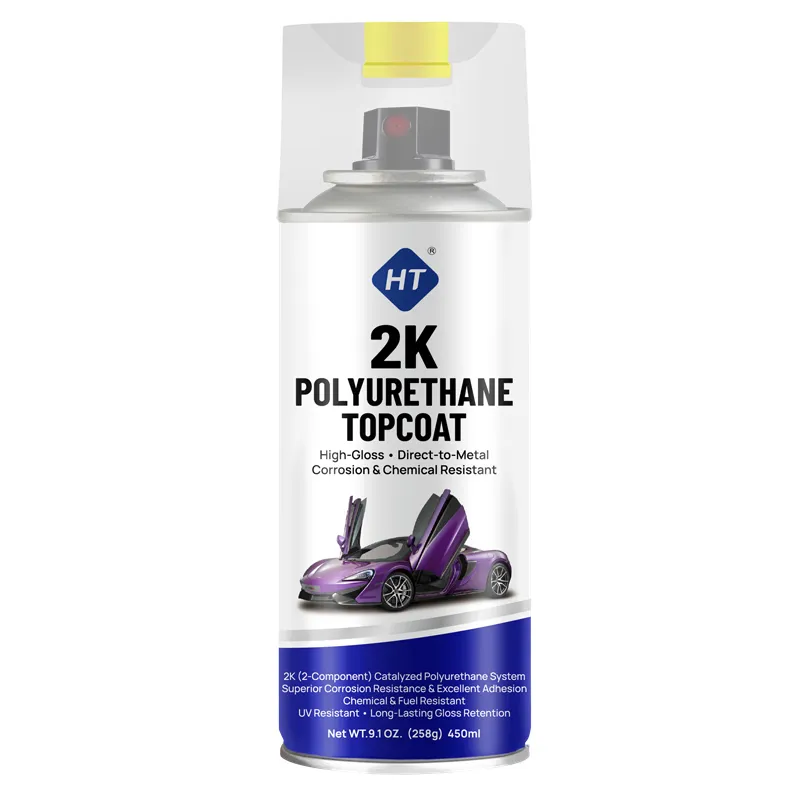
1. 2K Polyurethane (like HT-009): Thermoset crosslinked film. Excellent UV resistance when formulated with aliphatic isocyanate hardener. Best for automotive exteriors, outdoor machinery, and architectural metal. 5-7 year outdoor life.
2. Acrylic enamel: Thermoplastic film with good inherent UV stability. Acrylic polymers resist yellowing better than alkyds. Suitable for general outdoor use: fences, furniture, garden equipment. 2-4 year outdoor life.
3. Alkyd enamel: Traditional oil-based chemistry. Decent UV resistance with added stabilizers, but prone to yellowing and chalking over time. Budget option for non-critical outdoor applications. 1-3 year outdoor life.
4. Lacquer: Poor outdoor durability. Solvent-based lacquers chalk and fade quickly without significant UV protection. Not recommended for exterior use.
For tropical and high-UV markets (Middle East, Mexico, Australia), 2K polyurethane or high-solids acrylic is the minimum specification.
What should B2B buyers specify for outdoor spray paint orders?
Key specifications for UV-resistant spray paint sourcing:
- UV stabilizer package: Require both UV absorber (benzotriazole or benzophenone type) AND HALS in the formulation. Ask for the stabilizer supplier and loading level. - Accelerated weathering test: Request QUV or Xenon arc test results. Minimum standard: 1000 hours QUV-B with less than 5 delta-E color change and less than 10% gloss loss. - Pigment lightfastness: Specify Blue Wool Scale rating 7 or higher for colored products. For white, requireTiO2 grade (rutile is more UV stable than anatase). - Binder chemistry: Match to application. 2K PU for maximum durability, acrylic for cost-performance balance. - Warranty: Reputable OEM partners should offer a minimum 1-year outdoor warranty against fading, peeling, and chalking.
Huotian's HT-009 2K Polyurethane uses aliphatic isocyanate hardener with HALS stabilization, rated for 5+ years outdoor exposure in tropical climates.