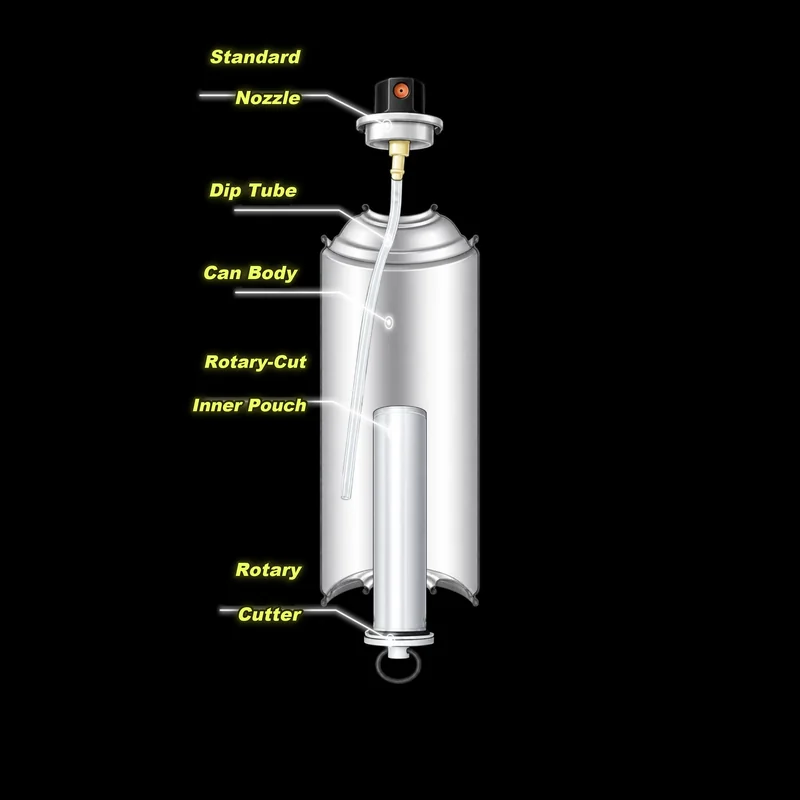
What is a two-component (2K) aerosol can?
A two-component aerosol can is a single aerosol pack that carries two reactive components which must not meet until the user is ready to spray. Reactive polyurethane, epoxy and ceramic formulations cannot sit pre-mixed in a can: once the hardener meets the resin the reaction starts and the product gels inside the pack.
So the can is built as two compartments. Component A (the resin, base or paint) fills the main body of the can. The curing agent is sealed inside a rotary-cut inner pouch that sits in the same body. The pack we build at our Zhongshan plant — HT-036, a fourth-generation recessed rotary-cut can — uses a standard aerosol nozzle and a standard dip tube, so it behaves like an ordinary aerosol on the shelf and on the filling line.
How does the rotary-cut mixing system work?
The sequence is short and it is entirely mechanical, with no tooling and no measuring.
Fill: the inner pouch is filled with the curing agent, then component A is added to the can body, and both ends are sealed.
Activate: at the moment of use, the user rotates the can clockwise. The rotary cut opens the pouch and releases the curing agent into component A.
Mix: the user shakes the can well, and the two components blend in the can body.
Spray: the mixed 2K formulation leaves through the same standard nozzle and dip tube as any other aerosol. There is no second can to open, no stirring stick, no mixing cup and no ratio to weigh out. The animation on the HT-036 page shows the whole cycle in about 25 seconds.
Why is the base of a 2K can recessed?
Two-component formulations are reactive systems, and reactive systems run at higher internal pressure than a standard solvent or water-based aerosol. The recessed (concave) base is the part of the can engineered for that load — it puts more metal into the geometry that has to hold the pressure, which is also what keeps the pack stable and standing correctly on a shelf or a conveyor.
Because pressure is the failure mode that matters with 2K, every can is water-bath tested for pressure and seal integrity before shipment. That test is done in-house, together with the filling, so the pack and the formulation are qualified as one unit rather than two separately purchased parts.
What are 2K aerosol cans used for?
The format is chosen whenever the chemistry only works when the two parts are mixed immediately before use. In practice that covers: two-component polyurethane and epoxy aerosols; 2K reactive adhesives, sealants and gap fillers; industrial maintenance coatings such as rust, electrical insulation and glass & tile systems; and automotive refinish 2K primers, clears and topcoats.
It also covers anything a brand wants to sell in a single-can 2K format — a ceramic glaze, a high-build 2K clear, a coloured 2K topcoat — because the user experience stays the same: turn, shake, spray.
Can an activated 2K can be stored and used later?
No. The rotary-cut action is a one-way activation: the moment the pouch opens, the curing reaction begins and the working time starts running. The pot life of an activated can is set by the formulation inside it, not by the pack, so the rule is to activate the can only when you are ready to spray the full job.
An unopened can is a different story. Kept sealed and stored below 50 °C, the pack has a 36-month shelf life, because component A and the curing agent never touch each other. That separation is the whole point of the design: the shelf life belongs to the pack, and the pot life only starts when the user decides it should.
What should a buyer check before starting a 2K aerosol program?
Four things decide whether a 2K aerosol program runs smoothly.
Filling compatibility: ask whether the can uses a standard nozzle and dip tube. If it does, your existing 2K filling line can run it without custom tooling.
Pressure qualification: ask how the cans are tested. Water-bath testing for pressure and seal integrity should be standard, not an extra.
Commercial terms: at our plant, minimum order is 1,000 cans per SKU and per colour, and the order-to-shipment lead time is around 20 days after the order and the sample are confirmed. Empty cans are available for buyers who fill in their own plant, and filled cans are available for buyers who want the finished product.
Export documentation: aerosols are dangerous goods. A shipment needs an MSDS/SDS in the languages of the destination market, the UN 1950 packaging certificate and the DG declaration. Ask for them before you book freight.