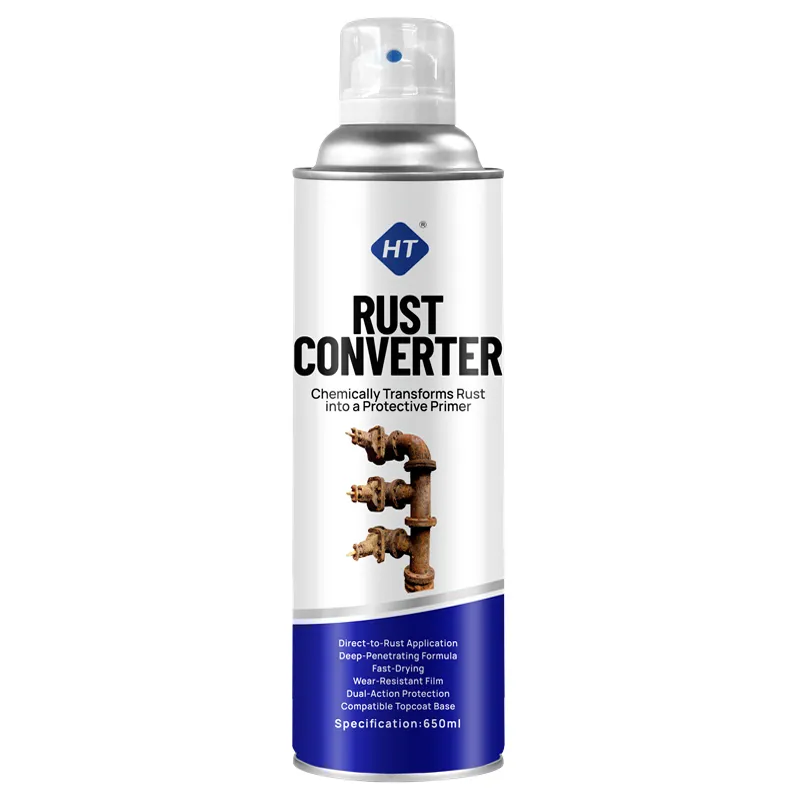
Rust converters are acid-based solutions that chemically react with iron oxide to form a stable black layer. Spray paints seal and protect surfaces. OEM buyers should source both -- rust converters for restoration work, rust-preventive spray paints for ongoing protection.
How Rust Converters Work
Rust converters contain tannic acid and phosphoric acid. When sprayed onto rusted surfaces, the acids react with iron oxide to form iron tannate or iron phosphate -- a stable, dark-colored compound. The acid penetrates the porous rust layer, chemically transforms rust into stable iron tannate, and forms a dark polymer layer ready for painting. Rust converters work best on moderate rust. Heavy flaking rust needs mechanical removal first.
When to Use Rust Converter vs Rust-Preventive Spray Paint
Use Rust Converter when surfaces are already rusty and you need to salvage rather than replace. Use Rust-Preventive Spray Paint when surfaces are clean metal and need ongoing protection. Use Both when in extreme corrosion environments like marine or industrial applications. At Huotian, we offer both HT-020 series rust converters and HT-001/HT-018 rust-preventive formulations.
OEM Sourcing Considerations
Key specs to verify: Salt spray resistance (ASTM B117) of 500-1000 hours, reaction time for rust converters (faster is better for production lines), pH level (skin-safe formulations below pH 3 are preferred), compatibility with your topcoat, and shelf life for moisture-sensitive products.