What's the Difference Between a Penetrating Oil and a Lubricating Spray?
The key difference is their purpose and physical properties. Penetrating oils (like our HT-030 Penetrating Spray) are formulated with low-viscosity solvents that wick into microscopic gaps between threaded fasteners, rusted bolts, and seized mechanisms. Their primary job is to break the bond of corrosion and free stuck parts — not to provide long-term lubrication. Lubricating sprays (like our HT-025 Multi-Purpose Lubricating Grease Spray) have a thicker, high-viscosity base that stays in place, forming a durable film between moving surfaces. Lubricants reduce friction over extended periods, while penetrants work for minutes to dissolve corrosion. As a rule: use a penetrant to free a stuck bolt, then apply a lubricant to keep the mechanism running smoothly long-term.
When Should I Use an Anti-Corrosion Coating Instead of a Lubricant?
Anti-corrosion coatings (like our HT-026 Rust Converter, HT-027 Cold Galvanizing Spray, and HT-007 Multi-Purpose Anti-Rust Lubricant) are designed to prevent or stop rust formation on metal surfaces. Use them when: (1) the part won't move or articulate — structural steel, pipe fittings, storage racks; (2) you need long-term corrosion protection (6-24 months) rather than temporary lubrication; (3) the surface will be exposed to moisture, salt, or chemical environments. A lubricating spray on static metal offers minimal corrosion protection — the thin film dries, runs off, or gets washed away. Anti-corrosion coatings leave a protective barrier that chemically or physically blocks oxidation. For example, HT-027 Cold Galvanizing deposits 96% pure zinc that acts as a sacrificial anode — even if scratched, the surrounding zinc corrodes first, protecting the underlying steel.
How Do I Choose the Right Aerosol for Common MRO Scenarios?
Here are the most common industrial MRO scenarios and the right product type: (1) Stuck bolt or rusted fastener → Penetrating oil (HT-030). Apply, wait 5-10 minutes, then loosen. (2) Door hinge, conveyor roller, or chain that needs ongoing lubrication → Lubricating grease spray (HT-025). It clings to vertical surfaces and won't drip. (3) Rusted equipment frame or pipe support → Rust converter (HT-026) first, then cold galvanizing spray (HT-027) for maximum protection. (4) Tools stored in humid conditions → Anti-rust lubricant (HT-007) — it displaces moisture and leaves a thin protective film. (5) Gear or bearing housing → Heavy-duty grease spray (HT-025). (6) Gas line or pneumatic fitting testing → Gas leak detector (HT-021) — a specialty detection spray, not a lubricant. Choosing wrong wastes time and money: a lubricant won't free a seized bolt, and a penetrant won't protect against next season's rain.
Can One Product Do All Three Jobs — Penetrate, Lubricate, and Protect?
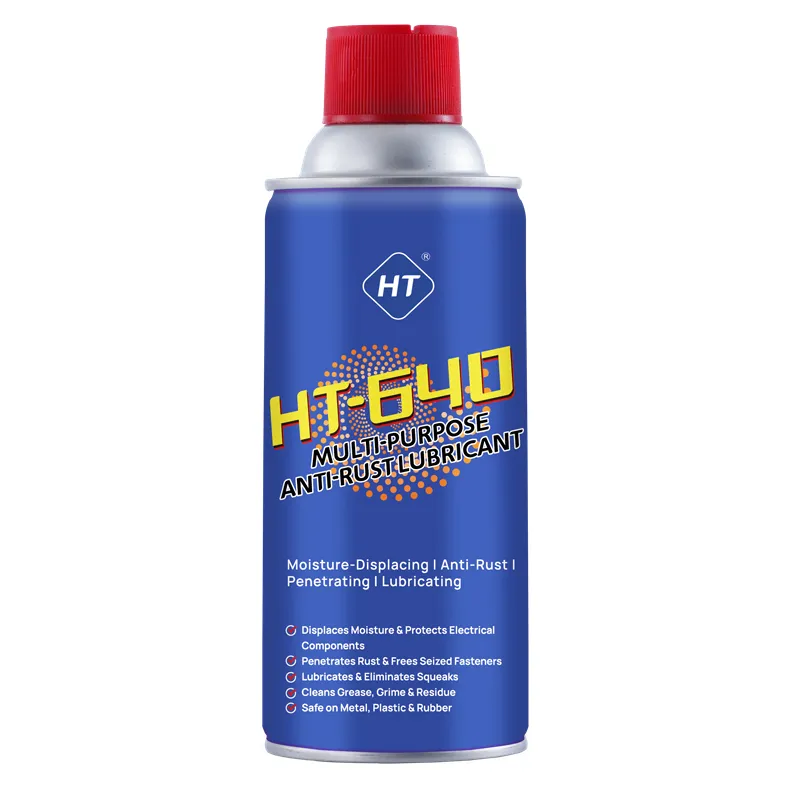
Some multi-purpose products (like our HT-007 Multi-Purpose Anti-Rust Lubricant) are formulated to cover two of three functions — in this case, penetrating action plus corrosion protection with a light lubricating film. But no single aerosol excels at all three. The trade-off is viscosity: a good penetrant is thin (low viscosity) to wick into tight spaces, but thin oils don't stay in place for long-term lubrication. A good lubricant is thick enough to resist squeeze-out, but won't penetrate seized threads. A good anti-corrosion coating forms a solid or semi-solid barrier, but isn't designed for moving parts. For professional MRO operations, we recommend stocking all three types. The cost per can is minimal compared to the labor cost of a technician struggling with a stuck bolt or revisiting a rust-damaged component.
How Long Do These Products Last After Application?
Durations vary significantly. Penetrating oils: short-term effect (hours to days) — the solvent carrier evaporates quickly. Reapply before attempting to loosen fasteners if the first application didn't work. Lubricating grease sprays: medium-term (weeks to months depending on environment) — the grease film clings to surfaces but can collect dust or be washed away by solvents. Re-lubricate based on manufacturer maintenance schedules. Anti-corrosion coatings: long-term (6-24 months for indoor applications, 3-6 months for outdoor/exposed) — zinc-rich coatings like HT-027 provide cathodic protection and last until the zinc layer is consumed. For best results: apply anti-corrosion coatings to a clean, dry surface in thin, even coats; store unused aerosols in a climate-controlled environment to maintain can pressure and formulation stability.