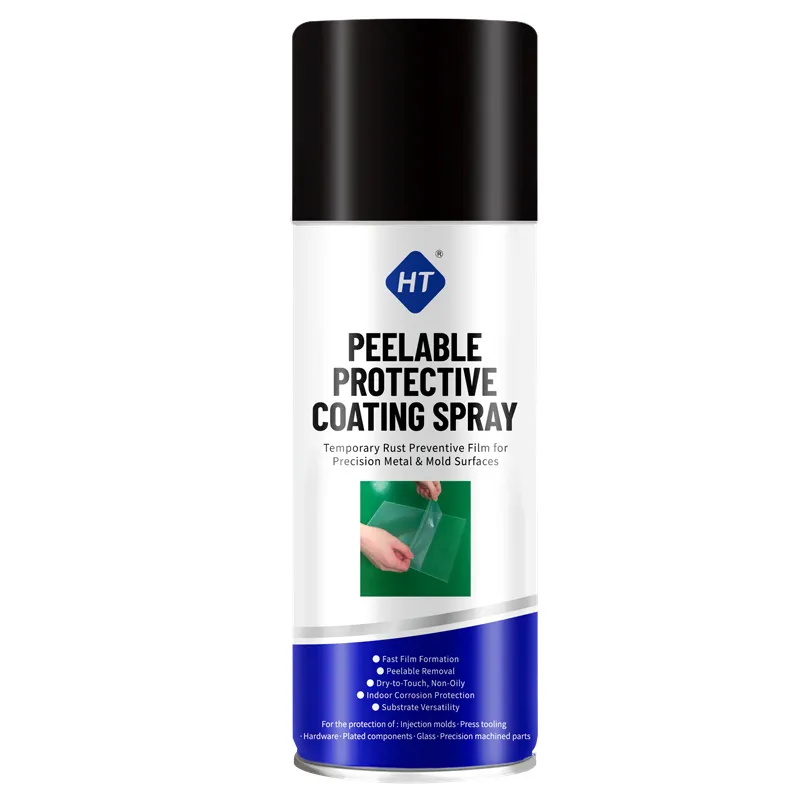
What is peelable coating and how does it work?
Peelable protective coating (also called strippable or removable coating) is a spray-applied film that dries into a continuous rubbery membrane. Unlike permanent paint, it is formulated with high polymer flexibility and low adhesion strength — it bonds enough to stay in place during use but releases cleanly when peeled.
The chemistry: typically an acrylic or vinyl-acrylic copolymer dispersion, sometimes with a small amount of plasticizer to control flexibility. The film dries by water or solvent evaporation, crosslinks minimally, and maintains enough internal cohesion to peel as a single sheet. Water-based peelable coatings are most common for indoor use; solvent-based versions provide better outdoor durability and faster drying.
Key properties: peelability (the film removes in sheets, not in fragments), flexibility (resists cracking on curved surfaces), cohesion (does not tear during removal), and substrate safety (does not stain or leave residue).
How it differs from masking tape: tape protects flat, simple areas; peelable coating conforms to complex 3D shapes, covers large areas faster, and leaves no adhesive residue. For automotive, aircraft, and industrial applications, peelable coating is often faster and more reliable than tape.
What are the main industrial applications for peelable coating?
Peelable coating serves protection roles across multiple industries:
1. Vehicle shipping protection: The single largest application. New cars, trucks, and boats are coated with peelable film before ocean or rail transport to protect paint from salt spray, rail dust, scratches, and road grime. At the destination, the dealer or customer peels the film off to reveal pristine paint. A full vehicle uses 3-5 liters of coating applied by spray gun or roller.
2. Factory and construction masking: Window glass, polished metal, countertops, and finished floors are protected during renovation or construction. Peelable coating replaces hours of tape-and-film masking. It is sprayed on, allowed to dry, and peeled off after work is complete. Windows in particular are a sweet spot — large glass areas are quick to coat and the film peels cleanly.
3. Powder coating and paint booth protection: Booth walls, fixtures, and racks in powder coating facilities accumulate overspray. Peelable booth coating is applied to booth walls; when the overspray layer builds up, the entire film is peeled off and re-applied, dramatically reducing booth cleaning time.
4. Seasonal equipment storage: Machinery, tools, and components are coated before long-term storage to protect against rust, dust, and moisture. The film is peeled off when the equipment returns to service. Marine equipment (boat fittings, outboard motors) benefits from seasonal peelable protection.
5. Temporary color change: Automotive enthusiasts use peelable coating for temporary color changes or to protect specific areas (hoods, mirrors) during track events. The film is removed when the temporary look is no longer wanted.
For B2B buyers: the addressable market includes automotive distributors, powder coaters, renovation contractors, industrial maintenance teams, and outdoor equipment dealers.
How do you apply and remove peelable coating for best results?
Application:
1. Surface prep: The substrate should be clean and dry. Oil, wax, and silicone residue prevent adhesion and cause the film to lift prematurely. For vehicles, a thorough wash and degreaser wipe are essential.
2. Temperature: Apply between 15-30 deg C. Too cold — the film becomes brittle and cracks on removal. Too hot — the film dries too fast and may trap solvent. Humidity above 70% slows drying and can cause blushing.
3. Application: Apply in multiple thin coats (3-4 passes) rather than one thick coat. Each coat should be 15-25 microns dry film. Total film build of 50-100 microns provides the strength needed for clean peeling. Thick single coats trap solvent and produce a weak, gummy film.
4. Drying: Allow 30-60 minutes between coats and 24 hours full cure before exposure to rain or heavy handling. The film is usable after 2-4 hours but reaches maximum strength after 24 hours.
Removal:
1. Start at an edge: Lift the film with a fingernail or plastic scraper at a corner or edge. Do not use metal scrapers on painted surfaces — they scratch.
2. Peel at a low angle: Pull the film back at approximately 30-45 degrees to the surface. Peeling perpendicular to the surface tears the film. Steady, even pressure produces the cleanest removal.
3. Large areas: For large panels, peel in strips rather than one giant sheet. Cutting the film into strips with a plastic knife or fishing line makes removal more manageable.
4. Residue: If any residue remains (rare with quality products), remove with isopropyl alcohol or a citrus cleaner. Do not use acetone on painted surfaces.
What should B2B buyers specify when sourcing peelable coating?
Six specifications determine peelable coating quality:
1. Peel strength: The film must hold in place during service but release without damage. Measured by 180-degree peel test (ASTM D903 or similar). Ideal range: 3-8 N/25mm. Below 3 N — film lifts too easily. Above 8 N — film is too aggressive, may pull paint or leave residue.
2. Film cohesion: The film must peel as a sheet without tearing. Cohesion is determined by polymer molecular weight and plasticizer balance. Test by peeling a 30cm wide strip — quality film removes cleanly without fragmentation.
3. Substrate safety: The coating must not stain or etch the protected surface, even after prolonged contact. Test on your actual substrates (painted metal, glass, plastic) with 30-day contact at elevated temperature (40 deg C). Verify no ghosting, discoloration, or adhesive transfer.
4. Outdoor durability: For vehicle shipping and construction applications, the film must withstand UV, rain, and temperature cycles for 30-90 days without degrading. Request QUV weathering data. Standard acrylic films last 30-60 days outdoors; premium formulations 90+ days.
5. Drying time and film build: Specify the wet film thickness to achieve the required dry film. A product requiring 100+ microns wet film for 50 microns dry has higher solvent load (slower drying, more cost). Efficient formulations achieve target film build in 3-4 passes.
6. Removal temperature window: Film removal becomes harder at low temperatures (brittle) and easier at high temperatures (softens). Specify the usable removal range: typically 10-35 deg C for standard acrylics. Cold-climate customers need a formulation that peels at 0-5 deg C.
Huotian's HT-028 Peelable Protective Coating Spray achieves 4-6 N/25mm peel strength, 50-80 microns film build in 3-4 coats, and removes cleanly from painted metal, glass, and powder-coated surfaces after up to 60 days outdoor exposure.