What is actually wrong with the tank in front of you?
Start from the condition of the tank, because each state needs a different first step. Chalky faded clear coat. Key scratches down to bare steel. A dent already filled and shaped. A replacement tank that arrived bare. One thing decides everything after that: a tank flexes slightly, sits inches above a hot engine, and gets splashed with petrol. Paint that cannot take solvent and movement fails at the seams and around the filler neck, not in the middle of the panel where it looks fine.
What is the correct prep order for a steel tank?
Work in this order, and do not jump to sanding before cleaning:
- Strip or scuff. Sound original paint gets scuffed with P400-P600. Failing lacquer, or more than two unknown layers, comes off.
- Remove decals and their adhesive with heat and a panel wipe, never with a scraper dragged across bare steel.
- Deal with rust. Light surface rust is removed mechanically. Pitting that has eaten into the metal is a specialist repair, not a paint job.
- Body filler goes onto bare, sanded steel, is shaped at P180 and finished at P320-P400, then sealed with primer before any topcoat, because filler is porous.
- Degrease last, with a wax-and-grease remover, and handle the tank with clean gloves. Petrol residue hides in the seam around the filler neck and at the sender opening.
Where does HT-009 fit into this job?
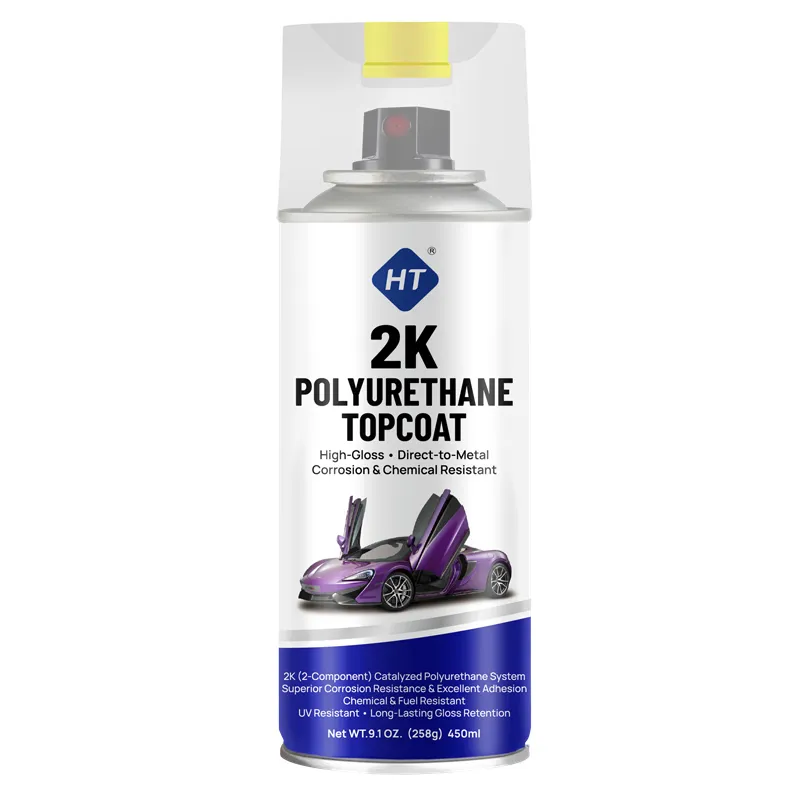
HT-009 is a 2K catalysed polyurethane topcoat. Two components react after they leave the can, and that cured film is what resists petrol, solvents and UV instead of softening under them. It can be applied direct to prepared metal, it holds gloss far longer than a single-stage lacquer, and one can covers roughly 15-18 sq ft, which is one tank with material left for the seams.
What application schedule should be used?
Treat this as a refinish job, not a rattle-can touch-up:
- Work at 20-25 C (68-77 F), humidity under 70 percent, out of direct sun.
- Two or three medium coats, never one heavy coat. Thick films trap solvent and pop.
- Flash 10-15 minutes between coats, until the film is tacky but no longer stringy.
- Tack-free in about 20 minutes, full cure in 24 hours. No sanding or polishing before that.
- Keep the filler neck and the seam masked until the topcoat is finished. Petrol spilled on a film that has not cured leaves a permanent dull patch.
Does a tank need a separate clear coat over HT-009?
Usually not, because the topcoat already carries the gloss. A clear earns its place when you are covering a metallic basecoat, when the customer wants to wet-sand and polish to a mirror, or when the depth has to read as show quality. If you do add clear, keep the same chemistry family and let the topcoat flash properly first. Mixing a catalysed clear over a film that is still wet is how runs and lifting start.
Why does a tank bubble or lift a week after painting?
Three causes, in the order they show up in real troubleshooting: contamination on the surface, most often petrol or silicone polish, which is why degreasing twice, once after sanding, matters; an incompatible layer underneath, because a strong solvent topcoat over a soft unknown lacquer attacks it; and recoating faster than the flash time allows. If lifting has already started, the only reliable fix is stripping back to bare metal. Spot repairs over a lifting film lift again.
When is repainting the wrong answer?
Repaint a steel tank that is sound. Do not repaint a tank with pinholes or rust blooming from the inside, a tank with a failed internal liner, or a polyethylene or polypropylene replacement tank where ordinary paint has almost nothing to grip and the surface needs activation first. Those are replacement or specialist repair cases, and paint only hides the failure until it comes back.