Why does repainting a lift truck matter beyond appearance?
In a warehouse, paint condition is a compliance and asset-value indicator:
- Safety visibility: ANSI Z535.1 and ISO 3864 signal colours let pedestrians identify a moving truck instantly. A truck worn to bare steel or faded to pale cream loses that signal in a busy aisle. - Corrosion control: paint is the only barrier between chassis, counterweight, and mast and the environment. Chips expose steel, and battery compartments accelerate the process with acid mist. - Inspection: OSHA and ISO 3691-1 style inspections read creeping corrosion as an early finding that triggers deeper inspection. - Residual value: rental fleets are re-valued on condition, and intact finish re-leases higher than mismatched touch-up work.
Safety, compliance, and resale together are why fleet managers fund touch-up even without a full-repaint budget.
What coating system does a forklift actually require?
OEM finishes are typically powder coat or a two-component system: epoxy primer for adhesion and corrosion resistance, then polyurethane topcoat for chemical and abrasion resistance. Field work should approximate that system, not contradict it.
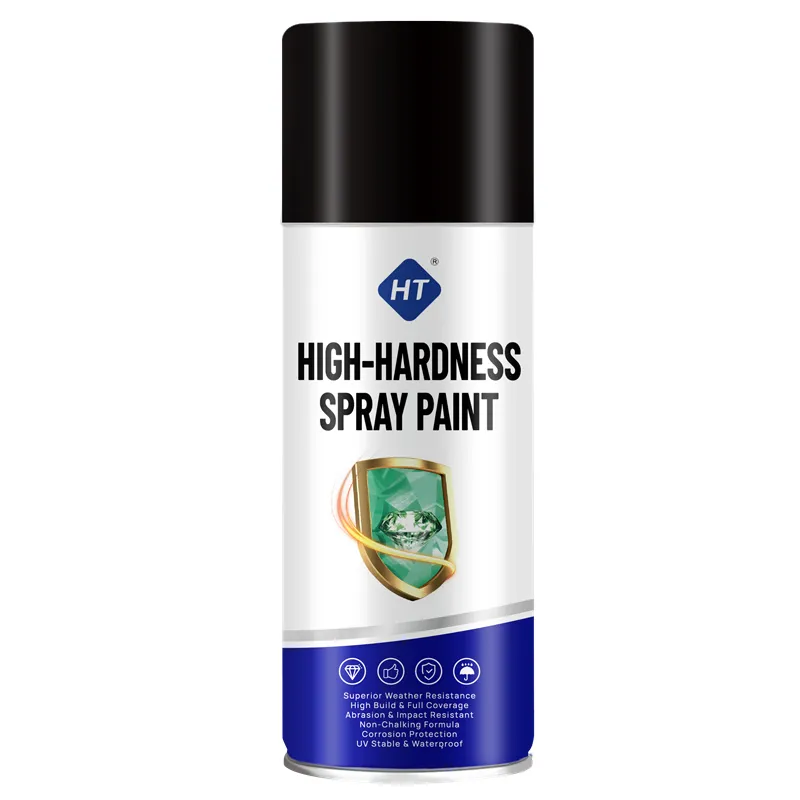
- Bare steel: prime first. HT-031 Epoxy Primer supplies the adhesion and barrier layer a topcoat cannot give on steel. - Topcoat: high-hardness acrylic-enamel or polyurethane. HT-027 High-Hardness Spray Paint is built for this duty - hydraulic fluid, battery acid splash, wash-down chemicals, abrasion. - Severe chemical exposure: full two-component polyurethane such as HT-009.
Film build: an aerosol pass gives roughly 40-60 microns, and two to three thin coats build 80-150 microns with better adhesion than one heavy coat. Respect flash times and never topcoat before the primer has flashed.
Which areas fail first, and how do you prepare them?
Five zones cause most lift truck coating failures:
1. Battery compartment: acid mist lifts paint from underneath and rust blooms outward. Neutralise with baking soda solution, rinse, dry, abrade, prime. Never coat over unneutralised acid. 2. Mast and chain area: grease, grit, constant abrasion. Degrease fully, then protect anchors, pins, and exposed hardware with a zinc-rich cold galvanising spray such as HT-017 where paint will be wiped off. 3. Counterweight and rim edges: impact chips, then flash rust within days. Treat light rust with HT-019 Rust Converter - do not paint over it. 4. Overhead guard: UV causes chalking and gloss loss before corrosion. UV-stable topcoats hold colour far longer. 5. Hydraulic surrounds: fluid attacks uncured film, so solvent-degrease and allow full cure.
In one line: degrease, neutralise acid, abrade to a dull profile, prime bare metal, topcoat inside the recoat window.
How do you run the program without taking trucks out of service?
Downtime is the first objection. Attach the work to maintenance already happening:
1. Bundle with scheduled service: a 500-hour or quarterly PM visit is the natural slot. Masking battery, decals, data plates, and lights takes minutes; focused touch-up on the failure zones takes 60-90 minutes. 2. Work off-shift: paint across a lunch break or between shifts so the cure window falls in idle time. 3. Stage the kit on the maintenance cart: five to ten cans per fleet colour, plus primer, degreaser, rust converter, abrasive pads, masking tape, gloves. If the kit is not within reach, the touch-up does not happen. 4. Respect the cure: handle after 24 hours, full chemical resistance in 5-7 days. 5. Log every truck: date, areas, product, batch, technician, photos - the evidence that justifies the spend in audits.
Standard: every truck touched up annually, and any chip reaching bare metal treated within the quarter.
How do safety colour standards influence the specification?
Safety colour is a regulated interface, so colour control is a purchasing criterion:
- Signal yellow: ANSI Z535.1 and ISO 3864 place lift trucks in the high-visibility yellow family, commonly matched to RAL 1003 or RAL 1023, standardised across all sites. - Contrast marking: black stripes and hazard chevrons belong to the same visibility system and must stay crisp against the base colour. - Colour tolerance: delta E of 2 or lower is the practical fleet target. Above that, panels visibly mismatch in daylight. - UV stability: yard trucks need UV-stabilised pigments, or yellow drifts green within a season. Extend the same colour family to aisles using aerosol line marking paint such as HT-012.
Always give the supplier a physical sample or OEM code, never a verbal colour name.
What should a B2B buyer verify in an aerosol paint supplier?
Fleet consumables are bought on repeatability, so audit the technical file as well as the colour card:
- Colour matching: match to a physical sample, quote a delta E target, and hold it across batches. - Pigments: lead-free and chrome-free, with REACH and RoHS conformity. - VOC compliance by market: CARB and OTC in the United States, EU Decopaint Directive 2004/42/EC in Europe. A formula legal in one market may fail in another. - Performance data: salt spray per ASTM B117, adhesion per ASTM D3359, hardness, chemical resistance - reports, not claims. - Batch consistency: colour and gloss drift is the number one fleet program complaint. - Commercials: MOQ per colour, can and valve options, market-compliant labels, UN 1950 documentation, and shelf life with date coding.
For distributors, a colour-matched private label line works best: the fleet standard carries your brand, replenishment is automatic, and the supplier owns formulation and compliance.