Why must load-path components on a crane stay unpainted?
Because periodic thorough examination depends on seeing the surface, and the regimes that govern it - LOLER in the UK, ASME B30 in North America, OSHA 1910.179 for overhead and gantry cranes - all assume the examiner can inspect the component.
- Wire rope: inspection looks for broken wires, corrosion, kinks, and diameter reduction. Paint hides all four. - Hooks and load pins: cracks initiate in the saddle and thread areas, which are crack-tested or visually examined. Coatings conceal both the crack and the stamped WLL and identification marking. - Shackles, swivels, and chain slings: the grade stamp and WLL must stay legible, and link wear cannot be measured through a film.
Coating a load-path component does not strengthen it. It only makes the next examination less capable of finding a defect.
Which parts of a crane should be coated?
Most of the machine, and it is the majority of the steel you are actually protecting:
- Boom sections, lattice chords, and jib stowage brackets. - Outrigger beams, boxes, and pad structures. - Carrier chassis, frame rails, deck, and access platforms. - Counterweight and ballast blocks, plus hazard striping. - Operator cab exterior and structural covers. - Bumper and visibility markings.
On a mobile crane working in coastal or harbour conditions, these surfaces take continuous salt exposure and mechanical abrasion. A harbour crane operating in a marine atmosphere sits in the C5 corrosivity band, which is where coating selection stops being optional - specified for more than 1,000 hours of salt spray, applied on a properly prepared profile.
Which coating system holds up on crane steel?
OEM cranes are finished with a two-component system for good reason: high-build epoxy primer plus a 2K polyurethane topcoat, giving durability and UV stability.
Field options that approximate it:
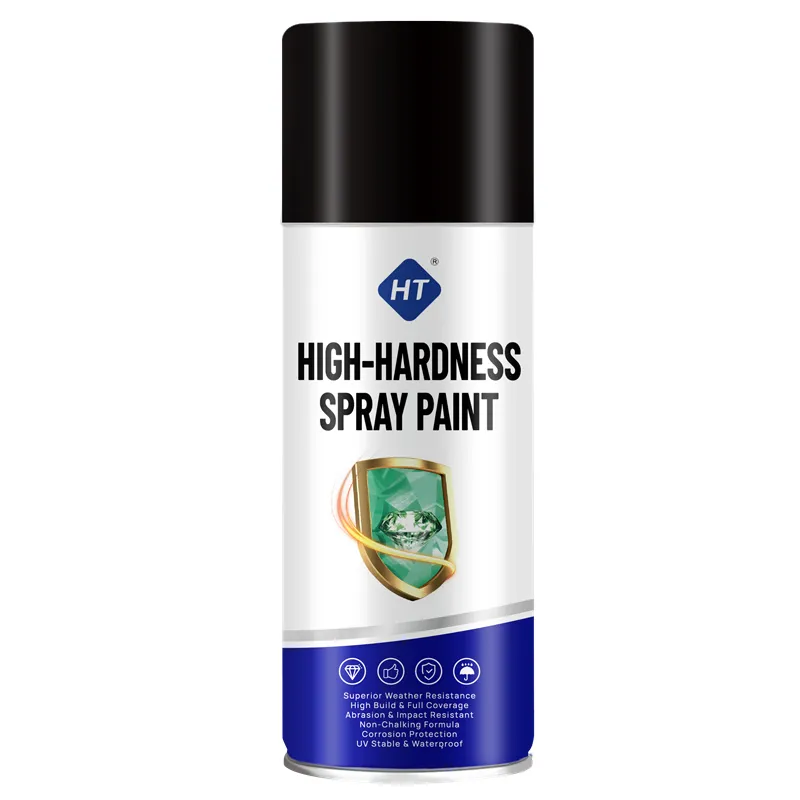
- Epoxy primer first on all bare steel - HT-031 Epoxy Primer for adhesion, barrier protection, and a build that tolerates a working environment. - Topcoat in high-hardness acrylic-enamel or polyurethane. HT-027 High-Hardness Spray Paint is suited to abrasion, hydraulic fluid, and wash-down exposure, while HT-009 2K Polyurethane covers heavy-duty and high-gloss fleet work. - Zinc-rich cold galvanising spray on fabricated repairs, weld seams, and new field cuts, where sacrificial protection matters most.
Cranes rarely get the full repaint a specification assumes, which is why touch-up capability on site is what actually keeps a fleet protected.
Where are the corrosion hot spots on a working crane?
Five areas account for most crane corrosion findings:
1. Telescopic boom wear pads and the sliding surfaces they run on, where fretting damage plus trapped moisture starts corrosion under the pad. 2. Outrigger boxes, which collect water, mud, and road salt with nowhere to drain. 3. Weld seams around the kingpin, turntable, and boom pivot points - coating is thinnest and stress is highest. 4. Carrier decks and cable trays, where standing water and abrasion combine. 5. Areas around the slew bearing, where coating work must stop short of the seal and race.
Detail work matters here: apply around fasteners, into lap joints, and along weld toes. A smooth coat over a bridge of rust simply lifts off in service.
Which markings and colour systems must painting preserve?
Lifting equipment carries information that paint can legitimately destroy - so protect it:
- Rated capacity and load charts on the machine: they must remain legible. Mask them, or apply a transparent protective film. Never overcoat printed charts. - Hooks, shackles, and slings: WLL and grade stamps stay visible, which normally means the component is not coated at all. - Inspection tags: many fleets use quarterly colour-coded tagging. Those tags identify the current examination period and must never be repainted to match a fleet colour. - Hazard marking: counterweights, outrigger pads, and projection zones take hazard striping or high-visibility colour. - Fleet livery: rental fleets require consistency, so hold topcoat colour within a tight tolerance against a physical sample.
A coating programme that respects these boundaries will pass an examination; one that does not creates findings that cost far more than the paint.
What should a crane fleet or distributor specify from a supplier?
Rental fleets and lifting equipment distributors buy on repeatability and evidence:
- High-build capability with a stated dry film thickness per coat, so crews can reach the specification in a known number of passes. - Salt spray performance per ASTM B117, adhesion per ASTM D3359, and chemical resistance reports - not claims. - UV stability: yellow and orange fleet colours fade and chalk quickly on outdoor machines, and a faded fleet reads as a neglected fleet. - Colour matching to a physical sample with a delta E target held across batches. - Galvanising-compatible zinc-rich repair product for welds, fabrication repairs, and field cuts. - VOC compliance for the destination market and UN 1950 dangerous goods documentation for shipment.
For distributors, the practical kit is a matched primer and topcoat in the fleet colour, plus a zinc-rich repair spray - a consumable that replenishes every time a machine comes back into the yard.