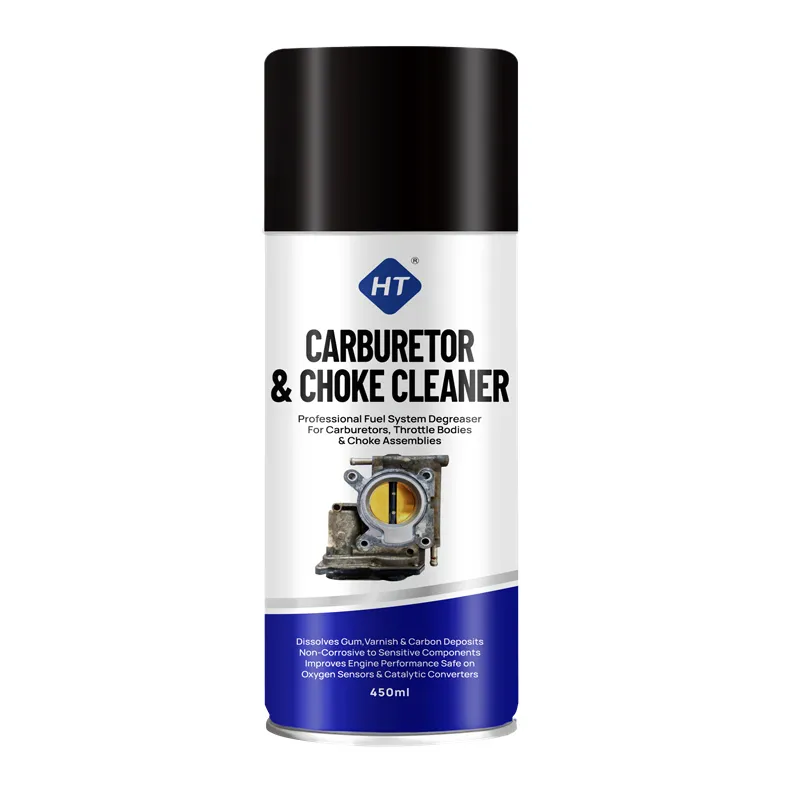
What is the difference between brake cleaner and carburetor cleaner?
The core difference is residue: brake cleaner is formulated to leave ZERO residue; carburetor cleaner is formulated to dissolve carbon and gum but may leave a light lubricating film.
Brake cleaner: A fast-evaporating solvent blend (chlorinated solvents like perchloroethylene in traditional formulas, or non-chlorinated blends of acetone, heptane, and alcohol in modern low-VOC versions). It evaporates completely in seconds and leaves no residue because brake components (pads, rotors, calipers) must be absolutely clean — any residue contaminates brake friction surfaces and causes noise or brake failure.
Carburetor cleaner: A more aggressive solvent blend (often including xylene, toluene, MEK, and surfactants) designed to dissolve hardened carbon, varnish, and gum inside carburetors and fuel systems. It penetrates and dissolves deposits that brake cleaner cannot break down. It may leave a thin film that is acceptable (even beneficial) in fuel systems but is WRONG for brake friction surfaces.
Key summary: brake cleaner = clean, no residue, evaporates fast. Carb cleaner = aggressive deposit dissolver, may leave film. Never use carb cleaner on brake parts (film causes brake issues); brake cleaner can be used for general parts cleaning but is not strong enough for heavy carbon.
When should you use brake cleaner?
Brake cleaner is the right tool for:
1. Brake service: Cleaning rotors, calipers, pads (before install), and backing plates. It removes oil, grease, brake dust, and contamination without leaving residue that would affect braking.
2. Metal parts degreasing: General degreasing of engine components, chassis parts, and workshop tools. Its fast evaporation makes it convenient for pre-paint cleaning on bare metal.
3. Electrical contact cleaning (non-chlorinated versions): Modern non-chlorinated brake cleaners are safe on most plastics and can be used for quick electrical contact cleaning — though a dedicated contact cleaner (like Huotian's HT-026) is preferred for sensitive electronics.
4. Removing grease before welding or painting: Brake cleaner's fast evaporation and zero residue make it good for pre-weld/pre-paint prep on metal.
Warnings: chlorinated brake cleaner (traditional perchloroethylene) is NOT safe on plastics and rubber, produces toxic fumes when heated (phosgene risk near hot metal/welding), and is being phased out in some regions. Non-chlorinated versions are safer and plastic-compatible — most modern automotive shops use non-chlorinated brake cleaner.
When should you use carburetor cleaner?
Carburetor cleaner is for deposit removal in fuel systems:
1. Carburetor rebuilds and cleaning: Dissolves hardened varnish, gum, and carbon in carburetor jets, passages, and throttle plates. Soak or spray, allow dwell, then rinse or blow out.
2. Throttle body cleaning: Removes carbon buildup on throttle bodies and intake components (note: on modern drive-by-wire vehicles, use a throttle body cleaner or follow the manufacturer's instructions — some throttle bodies have a protective coating that aggressive cleaners remove).
3. Carbon deposit removal: On pistons, valves, and combustion chambers in cases where the cleaner is applied through the intake. This is a professional technique.
4. General solvent for heavy deposits: Chain and cable cleaning, gummed-up mechanisms.
Warnings: carb cleaner is aggressive — it can damage paint, plastics, rubber seals, and sensors. Use it only where carbon/gum removal is the job. Always test on inconspicuous areas, and protect painted surfaces and plastic components when spraying. For fuel-injected engines, consider fuel system cleaner additives instead of solvent sprays for most maintenance.
Can they be used interchangeably, and what should B2B buyers stock?
Short answer: no, not for their primary jobs. Brake cleaner on a carburetor will not dissolve hardened carbon. Carb cleaner on brake parts leaves a film that can cause brake noise or contamination — a serious safety issue.
For distributors and retail buyers, both products are high-volume consumables and belong in the same lineup:
1. Stock both SKUs: Brake cleaner (non-chlorinated for modern safety/regulatory compliance) and carburetor cleaner. Customers will buy both for different jobs.
2. Consider a third SKU: Electrical contact cleaner (HT-026 type) for sensitive electronics, and a degreaser for general shop use. A complete cleaning chemical lineup increases basket size.
3. Verify solvent type: Chlorinated brake cleaner is being restricted in several markets (VOC and health concerns). Stock non-chlorinated brake cleaner as the default, with chlorinated available for specific professional uses where regulations allow.
4. Check VOC compliance: Both products are high-VOC aerosols. Verify compliance with your target market's regulations (CARB in California, EU VOC directive) — non-chlorinated and HFO-propelled formulas help meet limits.
5. Safety documentation: Both are flammable (non-chlorinated brake cleaner and carb cleaner are typically flammable; chlorinated brake cleaner is non-flammable but hazardous when heated). Ensure correct labeling, SDS, and storage (away from heat/ignition, below 50 deg C).