Why does agricultural steel corrode faster than the spec assumes?
Because farm environments attack coatings in four ways at once:
- Fertilizer salts such as urea, ammonium nitrate, and phosphates are deliquescent. They pull moisture from the air and keep the steel surface wet, so corrosion continues between rain events.
- Ammonia vapour in livestock buildings is alkaline and aggressive, and it is present continuously rather than seasonally.
- Feed, silage, and manure acids work with abrasion from grain and feed dust to break films down physically and chemically.
- Wash-down water and condensation cycling keep the equipment wet from the inside as well as the outside.
The hotspots repeat: spreader tanks, booms and spinner discs, auger flighting, hopper seams, bin base rings at grade, manure handling equipment, and the ceiling steel and trusses of poultry and swine buildings.
Why do alkyd and oil-based paints fail in fertilizer and livestock buildings?
Chemistry, not thickness. Alkyd and oil-based binders contain ester groups, and alkalis attack them in a reaction called saponification. Ammonia is alkaline, so an alkyd film in a poultry or swine house softens, chalks, and washes off - often within one or two seasons, no matter how well it was applied.
Two consequences follow:
- Specify 2K epoxy or epoxy-polyurethane systems for ammonia-exposed steel. Chemical resistance is the selection criterion here, not price per litre.
- Do not treat hot-dip galvanizing as the automatic answer. Zinc is amphoteric and is attacked by ammonia, so galvanized steel is not the safe default in high-ammonia zones without a suitable topcoat.
When a coating fails in these buildings, the cause is usually the binder class rather than the number of coats.
Which surfaces must not be coated, or need special care?
Several, and getting this wrong creates a bigger problem than corrosion:
- Feed and grain contact surfaces. A flaking film contaminates feed, so liners, not coatings, are the correct fix for feed bins and grain contact areas.
- High-abrasion interiors such as spreader hoppers and auger troughs, where any film is removed by the product itself. Specify a wear or polymer liner instead.
- Safety decals, certification plates, sight glasses, hydraulic rods, grease fittings, and rubber components.
One prep rule decides whether the job lasts: wash fertilizer residue off with water before coating. A wipe is not enough - dried fertilizer dust re-wets under a new film and drives corrosion from beneath it, which is the most common failure in fertilizer handling equipment.
How should field prep and repair be done?
In this order:
1. Wash to dissolve the salts, allow to dry, then degrease and abrade. Never coat steel that still shows fertilizer dust or damp patches.
2. Prime bare or abraded steel with a zinc-rich cold galvanising such as HT-017, including edges, weld seams, and the inside of bolt and drain holes.
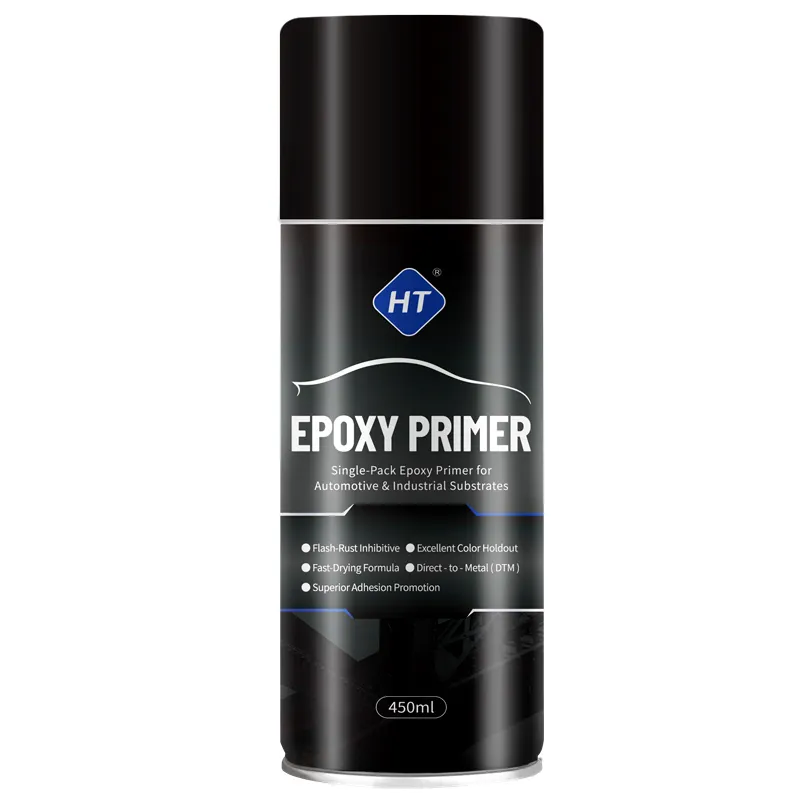
3. Build the chemical-resistant system for ammonia and fertilizer exposure with HT-031 epoxy primer and HT-027 topcoat.
4. Work only when the substrate is dry and at least 3 degrees above the dew point, and within the product's temperature range.
Where pitting has already removed section, coating is not the repair - replacement is. Coatings protect steel that is still doing its job structurally.
How does the maintenance calendar follow the farming cycle?
Equipment cannot be out of service during planting or harvest, so the maintenance window is set by the season, not by the coating:
- Post-harvest: wash and repair spreading and harvesting equipment before it goes into storage.
- Pre-season: inspect and touch up the planters, sprayers, and tractors that will run first.
- Livestock buildings: schedule work between flocks or herds, when the house can be washed and ventilated.
- Before winter storage: the highest-value intervention, because equipment stored wet with fertilizer residue corrodes all winter.
Photograph each inspection. In agriculture, replacement decisions are usually made on visual evidence, and a dated photo record is what keeps a repair budget ahead of a rebuild.
What should distributors stock for agricultural accounts?
A short list that covers the recurring work:
- Zinc-rich cold galvanising for bare steel, abraded galvanizing, and weld areas.
- Epoxy primer and a hard topcoat as the chemical-resistant system for ammonia and fertilizer exposure.
- Aerosol touch-up sizes matching the bulk system, so a field crew can repair a spinner disc, a hinge, or a guard without mixing anything.
- A durable marking paint for equipment identification and safety markings.
Farms and fertilizer dealers buy on availability and on whether the repair holds until the next season - they re-buy from whoever's product did. Stocking the system that survives the second season is the commercial argument, and it is stronger than any price-per-can comparison.