Why is sticker residue so hard to remove, and how does a remover actually work?
Adhesives are engineered to bond — pressure-sensitive adhesives (PSAs) used in stickers and labels rely on viscoelastic properties that resist both separation and flow. When you peel a sticker, the adhesive either stays on the label (clean peel) or transfers to the surface (residue). Whether residue remains depends on the adhesive type, surface energy of the substrate, and how long the sticker has been in place.
Adhesive removers work by one of three mechanisms:
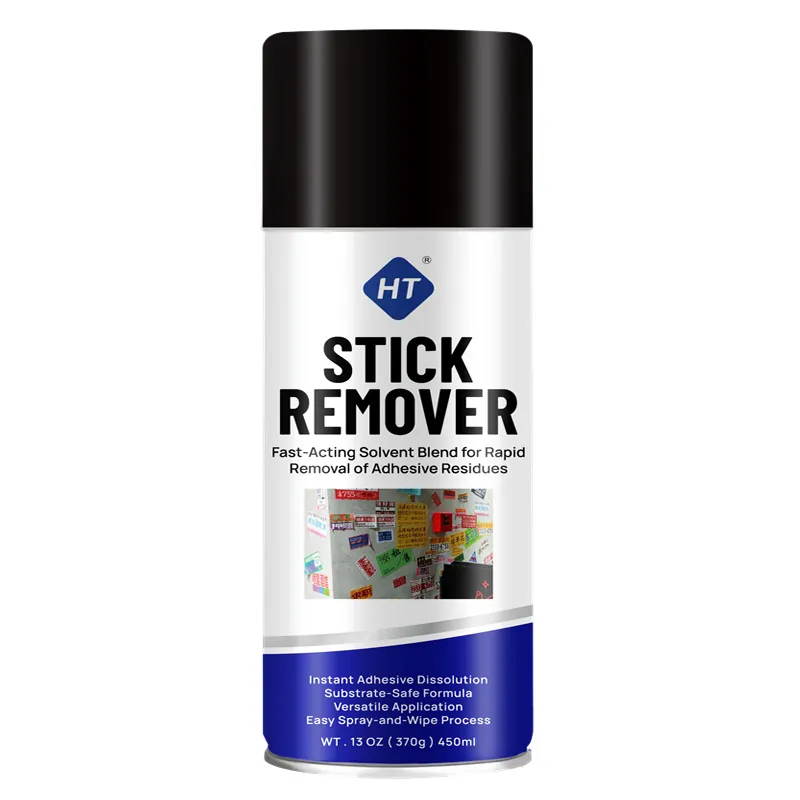
Solvent dissolution: Organic solvents (d-limonene from citrus, naphtha, isopropyl alcohol, or ester blends) dissolve or swell the adhesive, reducing its cohesive strength. The residue then wipes away. This is the mechanism used by most aerosol adhesive removers like Huotian's HT-023 Sticker Remover.
Penetration and lifting: Some removers penetrate between the adhesive and the substrate, breaking the bond at the interface. The sticker lifts off as a sheet, and the residual film wipes clean.
Emulsification: Water-based removers emulsify the adhesive with surfactants, allowing it to be washed away. Generally weaker on aged, cured adhesives but safer on delicate surfaces.
The key to damage-free removal is choosing a solvent that dissolves the adhesive faster than it attacks the substrate. A citrus-based (d-limonene) remover dissolves PSAs effectively while being safe on painted surfaces — this is why it is the industry standard for automotive decal removal.
What is the proper technique for removing stickers from different surfaces?
Technique differs by surface type:
Painted surfaces (cars, machinery, painted walls): Use a citrus-based remover (d-limonene). Spray generously, wait 3-5 minutes for the solvent to penetrate, then lift the sticker edge with a plastic scraper or credit card. NEVER use a metal scraper on painted surfaces. After removal, wipe the residue with a clean cloth. Wash and wax the area afterward to restore protection.
Glass: Any remover works — citrus, alcohol, or commercial products. Glass is non-porous and solvent-resistant. Spray, wait 2-3 minutes, and the sticker peels cleanly. For stubborn residue, use a razor blade at a shallow angle (nearly flat against the glass) to scrape. Never use razor blades on coated or tinted glass.
Plastic: Risk of damage is highest here. Some solvents (acetone, toluene, MEK) attack and soften many plastics, causing whitening or crazing. Use a citrus-based remover or isopropyl alcohol and test on an inconspicuous area first. For polypropylene and polyethylene (common in automotive interior), solvent resistance is good but adhesive bond is weak — removal is usually easy.
Stainless steel and metal: Robust surface — most removers are safe. Citrus or commercial removers work well. For industrial label removal, apply, wait, and use a plastic scraper. Avoid leaving remover on for extended periods (d-limonene can leave a film that requires cleaning).
Wood and laminate: Use sparingly — solvents can strip finish or stain wood. Apply remover to a cloth, not directly to the surface. Wipe, wait briefly, then remove. For finished wood, a mild citrus remover is safest.
Fabric and upholstery: Adhesive residue on fabric is removed with alcohol-based products (test first) or specialized label remover applied to a cloth. Never soak fabric in solvent — it can spread the adhesive further.
How do you remove aged, sun-baked, or industrial-grade labels?
Aged labels and industrial-grade adhesives are the hardest removal cases. Here is a progressive approach:
Level 1 — Heat first: Warm the label with a hairdryer or heat gun (not on paint, which can blister). Heat softens the adhesive, allowing clean peeling. Hold the heat source 10-15cm away and move continuously. Do not overheat — this damages paint and some plastics.
Level 2 — Chemical + heat combination: Apply remover, wait 3-5 minutes, then apply gentle heat. The combination dissolves and softens the adhesive simultaneously. This is the most effective technique for aged decals and bumper stickers.
Level 3 — Multiple passes: Stubborn residue may need 2-3 applications. Spray, wait, scrape, re-spray. Never force scraping on residue that has not softened — this scratches the surface.
Industrial labels (shipping labels, asset tags, UL labels): These use aggressive acrylic adhesives designed to resist removal. Use industrial-grade remover, allow 5-10 minutes penetration, and use a plastic scraper with firm, steady pressure. For metal equipment, a razor blade at a low angle after solvent penetration works well.
Prevention tip: for B2B buyers who apply labels in production, specify removable adhesive labels for temporary applications (shipping, instructions) and permanent adhesive only for permanent markings. This reduces customer complaints about residue.
What should B2B buyers look for in an adhesive remover product line?
For distributors and OEM buyers, consider these factors when sourcing sticker remover products:
1. Chemistry selection: Stock at minimum a citrus-based (d-limonene) remover for paint-safe applications and an industrial-strength solvent remover for heavy duty. These cover 95% of customer needs. Consider an alcohol-based product as a third SKU for electronics and fabric applications.
2. Safety profile: Citrus-based removers are low-toxicity and pleasant-smelling — good for retail. Industrial solvent removers have stronger odor, flammability, and VOC considerations. Check flammability classification (UN1950 aerosol) and VOC compliance for your target market.
3. Surface compatibility documentation: Provide a compatibility chart showing which surfaces each product is safe on (paint, glass, plastic types, metal, wood, fabric). This prevents customer damage claims and builds trust.
4. Packaging: 400ml aerosol is the retail standard. Consider a larger format (750ml-1L) for industrial users. Include a plastic scraper in a kit format for retail — it improves results and increases perceived value.
5. Private label opportunity: Sticker remover is a high-frequency, consumable product with strong repeat purchase. It is a good SKU for private label brands entering the cleaning and automotive care category — simple formulation, proven demand, low regulatory complexity (non-paint aerosol).
Huotian's HT-023 Sticker Remover uses a d-limonene-based formula with a precision spray nozzle, effective on painted surfaces, glass, plastic, and metal, and is suitable for both retail and industrial label removal applications.