Why do condenser coils corrode faster than every other HVAC component?
Coils are a corrosion target by design. The fins are aluminium or copper foil around 0.1 mm thick, folded into a huge surface area. Three mechanisms dominate the damage:
- Chloride attack: salt spray from coastal air, road de-icing, or cooling tower drift pits aluminium and eventually pinholes the copper tubes. - Organic acid attack: kitchen exhaust, urban pollution, and VOCs cause formicary corrosion - fine pitting that leaks through the tube wall with no visible surface rust. - Galvanic and white rust: where aluminium fins touch copper collars, moisture plus dissimilar metals drives corrosion and airflow-blocking deposits.
The commercial consequence is what matters: coil failure means refrigerant loss, then compressor damage, then an emergency replacement costing several times a coating program.
Which coating chemistries work for field-applied coil protection?
Factory protection is normally an oven-cured epoxy or phenolic e-coat at 15-25 microns - the most durable option, and impossible to apply in place.
Field options fall into two families:
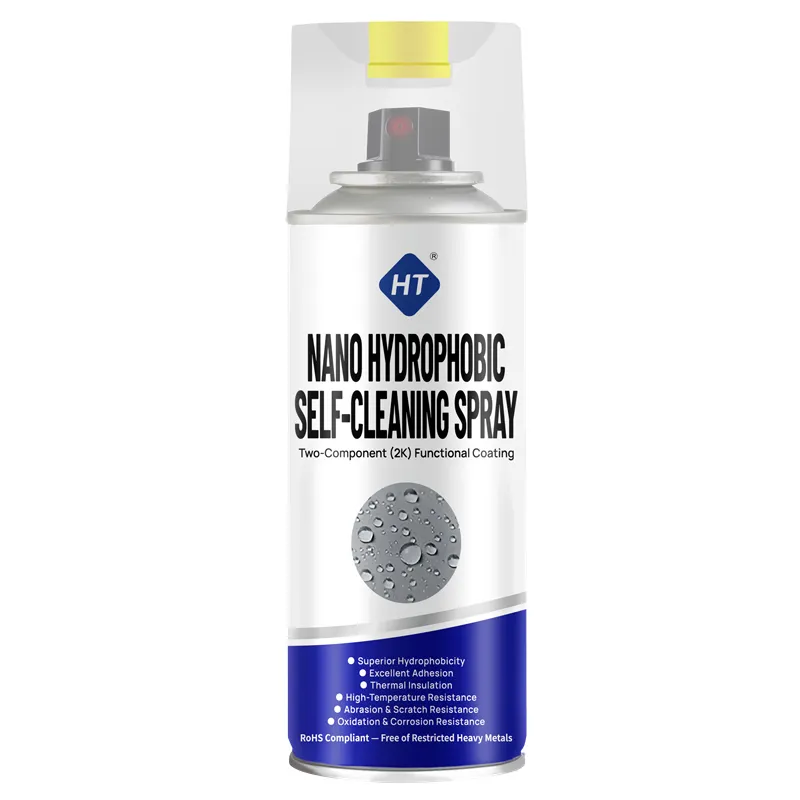
1. Polymer films: urethane, polyester, or epoxy sprays. Mechanically tough, but add measurable thermal resistance and are hard to spread evenly through dense fins. 2. Thin hydrophobic nano coatings: organosilane or ceramic-modified films of 1-5 microns. Water beads and runs off instead of sitting between fins, so salt and moisture never get a foothold. HT-024 Nano Hydrophobic Self-Cleaning Spray belongs to this family and applies by aerosol or pump spray to a clean, dry coil.
Specify by environment: polymer films for aggressive coastal or industrial exposure, thin hydrophobic coatings for humid, moderately contaminated sites where efficiency loss is unacceptable.
How much does a coating affect heat transfer and efficiency?
This separates a competent spec from a costly one. Industry field data is consistent: a thin, correctly applied film has negligible effect on capacity, while a medium or heavy film raises head pressure measurably - tests on R-410A equipment have shown medium coats eroding the energy savings the coating was meant to protect.
Temperature is the second constraint. Most field coatings - and factory e-coats - start degrading around 300 deg F (150 deg C), and prolonged exposure above 300-350 deg F breaks the film down. Coated coils suit condenser, evaporator, and low-temperature sections. They do not belong on hot gas discharge lines, electric heat sections, or any continuously hot surface.
Contractor rule: thin and even beats thick and cheap. Two light passes outperform one heavy one.
How often should coils be cleaned - coated or uncoated?
Coatings reduce corrosion, not fouling. Dirt still lands on the fins, so treated coils should be cleaned on the same schedule as untreated ones.
A defensible frequency:
- Annual: most commercial evaporator and condenser coils. - Quarterly: condenser coils in high-debris areas, or near an open cooling tower. - Monthly: any unit within one mile of saltwater or in a severe pollution zone.
Method matters as much as frequency. Use a pH-neutral, non-caustic cleaner - acids and strong alkalis attack aluminium and lift coatings. Rinse inside-out, keep pressure moderate so fins are not folded flat, and straighten bent fins with a comb. Greasy kitchen units need a degreaser stage such as HT-029 before the coil cleaner can reach metal.
What preparation is required before applying a field coating?
Field coatings fail from preparation far more often than from product choice. The sequence:
1. Clean: remove grease, dust, and biological growth with a pH-neutral cleaner; degrease greasy coils first. 2. Repair: straighten fins, remove white rust, and clean fin-to-tube joints where corrosion starts. 3. Rinse and dry completely: trapped moisture blisters the film and delaminates it within a season. 4. Apply thin: several light passes from different angles so the film reaches fin depth. Never flood the coil - a sagging coat blocks airflow. 5. Cure before restart: running the fan into a tacky film blows dust into it permanently.
Never coat a dirty coil. Coating over contamination locks in dirt and corrosion, and the film peels in sheets within months.
How should a multi-site program be structured, and which environments justify coating?
For a portfolio - retail chains, hotels, schools, warehouses - treat coil protection as asset management: survey and grade every coil, prioritise by consequence, standardise the kit (bulk coating plus aerosols for fin edges and tube collars), log date, unit ID, product, batch and before/after photos, and confirm the OEM warranty position in writing before spraying.
Coating is justified where uncoated coil life collapses:
- Coastal and marine sites within roughly one mile of saltwater - Cooling tower adjacent, where drift carries concentrated salts - Pulp, paper, cement, textile, and chemical plants - Commercial kitchens and supermarkets with grease-laden exhaust - Dairy and ammonia-cooled food facilities - High-pollution urban corridors
Documentation is what turns a maintenance expense into a capital-avoidance record finance will fund again.