Why are manufacturers looking for electroplating alternatives?
Traditional chrome electroplating uses hexavalent chromium (Cr6+), a known carcinogen that is heavily regulated worldwide. The EU's REACH regulation has listed chromium trioxide for authorization, requiring companies to apply for special permits. California's Proposition 65 requires warning labels on products containing hexavalent chromium compounds.
Beyond regulation, electroplating has practical limitations: it requires immersion tanks, so only parts that fit in the tank can be plated. Large structural components, assembled products, and on-site repairs are impossible. Turnaround time is measured in days or weeks, not hours. And setup costs for small batches are prohibitive.
Chrome-effect spray paints address all three pain points: no toxic Cr6+, no size limitations, and same-day turnaround. The trade-off is that spray chrome does not achieve the exact mirror reflectivity of electroplated chrome, but modern formulations get remarkably close.
How does chrome spray paint compare to electroplating in performance?
Here is the honest comparison based on standard test methods:
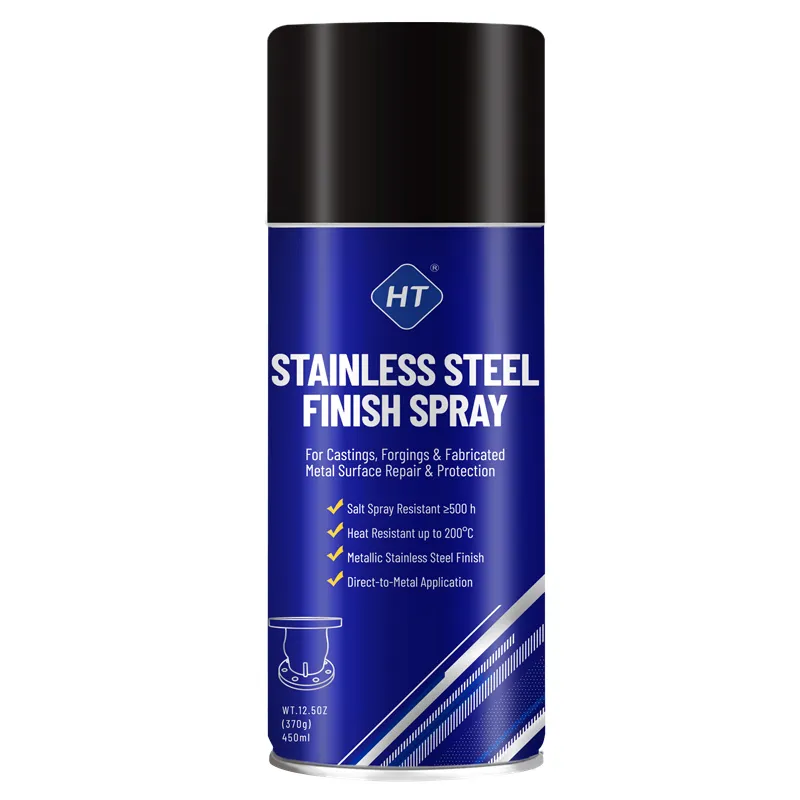
Reflectivity: Electroplated chrome achieves 60-70% specular reflectance (mirror-like). Premium chrome spray paints like Huotian's HT-008 Stainless Steel Finish Spray achieve 50-60% reflectance. The difference is visible side by side but not obvious in most applications.
Adhesion: Electroplated chrome bonds at the molecular level through electrodeposition (5B crosshatch). Chrome spray paint requires proper surface preparation and primer for 4B-5B adhesion. On well-prepared surfaces, bonding is comparable.
Corrosion resistance: Electroplated chrome with nickel underlayer passes 96+ hours salt spray (ASTM B117). Quality chrome spray paint with clear coat achieves 48-72 hours. Adequate for most non-marine environments.
Heat resistance: Electroplated chrome can withstand 500 deg C+. Chrome spray paint typically rated to 200 deg C (HT-008). Sufficient for automotive trim, wheels, exhaust covers but not exhaust manifolds.
Cost per part: Electroplating typically costs $5-15 per square foot for small parts. Chrome spray paint costs $0.50-2 per square foot depending on the system. For large surfaces, the cost advantage of spray chrome is dramatic.
Winner per application: Electroplating wins on absolute performance and extreme environments. Chrome spray paint wins on cost, turnaround time, and flexibility for non-extreme applications.
What is the process for achieving a professional chrome spray finish?
Professional chrome spray results require a three-step system:
Step 1 — Substrate preparation: The surface must be perfectly smooth because chrome finishes amplify every imperfection. Fill scratches and pinholes with body filler. Sand progressively from 320 to 800 to 1200 grit. The smoother the base, the more reflective the chrome finish.
Step 2 — Black base coat: Chrome spray paints are translucent and rely on a black base coat for depth and reflectivity. Apply 2-3 wet coats of high-gloss black paint. Allow 12-24 hours to fully cure. Wet sand any orange peel with 1500 grit.
Step 3 — Chrome top coat: Apply the chrome spray in light, even coats. Do NOT apply heavy wet coats — this causes clouding. Multiple thin coats (4-5 passes) build reflectivity without losing transparency. Hold the can 10-12 inches away and move at a steady speed.
Step 4 (optional) — Clear coat: A 2K polyurethane clear coat like HT-009 extends durability and corrosion resistance. Allow chrome coat to cure 24 hours before clear coating. Note: some clear coats can dull the chrome effect due to solvent attack. Test on a scrap piece first.
Critical tip: Chrome spray paint is humidity-sensitive. Spray when relative humidity is below 60%. High humidity causes hazing and loss of reflectivity.
When should B2B buyers choose spray chrome over electroplating?
Spray chrome is the right choice in these scenarios:
1. Large parts: Automotive bumpers, furniture frames, architectural elements that cannot fit in electroplating tanks. No size constraint with spray application.
2. On-site repairs: Touch-ups on installed equipment, signage, restaurant fixtures. Cannot disassemble and transport to a plating shop.
3. Small batch or one-off production: Electroplating minimum order charges make low-volume uneconomical. Spray chrome has no minimum.
4. Mixed material assemblies: Products combining metal, plastic, and wood — electroplating only covers metal. Spray chrome can create a uniform finish across all materials.
5. Regulation-heavy markets: EU customers needing REACH-compliant alternatives. Chrome spray paint uses aluminum pigment, not hexavalent chromium.
Stick with electroplating when: You need maximum corrosion resistance (marine, chemical exposure), maximum heat resistance (exhaust components), or the absolute highest reflectivity (luxury fittings, medical equipment).