What actually destroys wheel paint first?
Not sunlight. On a motorcycle wheel the attack order is brake dust, which is alkaline, hot and baked on; chain lube flung onto the rear rim; road salt; kerb scuffs; and the tyre machine. That is why a wheel painted with a general-purpose aerosol looks tired after one season while the tank on the same bike still looks fresh. The wheel is the part that gets chemically attacked.
What does prep look like when everything is round?
The same steps as any panel, adapted to a wheel:
- Wheel off the bike with the rim fully accessible.
- Clean with a brake-dust remover first, scrub, then wipe with a wax-and-grease remover. Never use silicone tyre dressing or silicone polish before painting. It migrates and causes fisheyes that more paint will not cover.
- Feather chips at P400, scuff sound paint at P600, and give bare alloy a light etch or an adhesion primer.
- Mask the tyre, the valve, brake disc mounting faces, axle spacers and bearing seats. Paint in a bearing seat or on a disc face is a fit and safety problem, not a cosmetic one.
Why is HT-004 built for wheels rather than for panels?
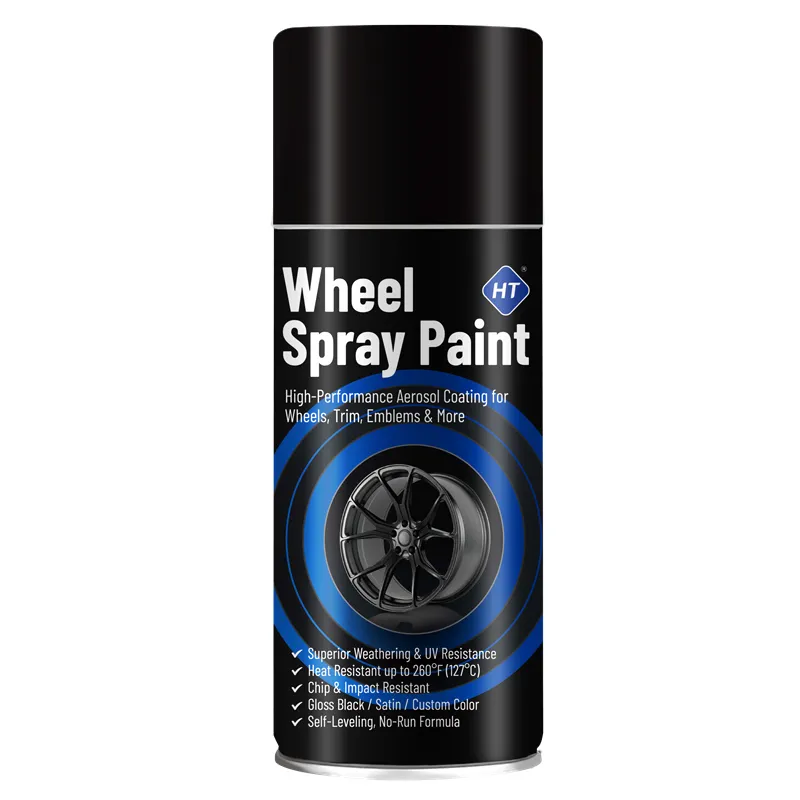
HT-004 is formulated for wheels, trim and emblems: chip and impact resistance for kerb and tyre-machine contact, a self-levelling no-run formula so spokes and the rim well coat evenly without curtains, UV and weathering resistance so a gloss black does not chalk in one season, and heat resistance to 260 F (127 C). A wheel in road use stays well inside that range. Calipers and discs run far hotter and need a dedicated high-heat product and a different procedure.
How many coats, and on what schedule?
Two to three light-to-medium coats with a 10-minute flash between them. Keep the can moving and rotate the wheel so you are always painting a moving target. Coverage is roughly 12-18 sq ft per can, enough for a pair of rims. Touch-dry in around 20 minutes, but leave the wheel 24 hours before handling and 48 hours before a tyre goes back on if the schedule allows. Rim edges take the abuse, so give the rim lip the final pass.
What about spoked wheels, TPMS and balance weights?
On spoked wheels, paint the rim and hub with the spokes out where possible. Paint on nipple threads turns wheel truing into a fight. Mask TPMS sensor bodies and never paint the valve stem. Balance weights come off before prep, go back on after curing, preferably on the inside face where there is room, and the wheel is rebalanced afterwards.
Will a tyre shop ruin it during mounting?
Often, at the rim lip, because that is exactly where mounting machines clamp and lever. Two things reduce the damage: give the paint 48 hours of cure, and tell the fitter the rim is painted so rim protectors get used. Keep the HT-004 can. Touch-up with the same product at the same film build disappears; touch-up with a different black never matches.
When should a wheel not be painted at all?
Do not paint a cracked or bent rim, corroded alloy with white bloom reaching into the bead seat, or a wheel used daily on salted roads where a powder coat is available and durability outweighs finish matching. Powder coat and an aerosol programme are different tools: powder for volume and maximum durability, aerosol for touch-up, small runs and matching a colour across a trim range.