Why is line identification treated as a compliance item?
Because the people working on a pipe need to know what is inside it before they open anything. The reference scheme in the United States is ASME/ANSI A13.1, Scheme for the Identification of Piping Systems; ships use ISO 14726, and many plants follow a local or owner-specific scheme instead.
What these schemes ask for is consistent in structure:
- A colour assigned to the service category.
- A legend or label that names the service, because colour alone does not identify anything.
- Flow direction arrows where direction matters for safety.
- Placement rules: identification at penetrations through walls and floors, near valves, at branches, and at defined intervals.
Check the current edition and your jurisdiction before specifying, because colours and placement details are revised over time, and an audit will be judged against the edition your facility claims to follow.
Why is colour alone never enough?
Colour groups services into broad categories; it does not name what is in the pipe. Two services in the same category become ambiguous without a legend, and colour conventions differ between facilities, countries, and standards - a colour scheme imported from one site will not read correctly at another.
The practical consequences:
- Staff trained on one scheme misread lines marked to another.
- Colour-blind personnel rely on the legend anyway, so contrast and label legibility are part of compliance, not decoration.
- An undocumented mix of schemes produces lines nobody trusts, which is worse than no markings at all.
The fix is governance: one documented scheme, one line list that maps every line to its service, and training so the next crew marks it the same way.
Where does marking go wrong in practice?
The recurring defects are all applied-science failures rather than design failures:
- Labels or paint applied to a greasy, dusty, or damp pipe. Adhesive fails and paint flakes, usually within a year.
- Labels stuck directly onto insulated pipe instead of the jacketing, where the surface temperature and condensation defeat the adhesive.
- Missing identification exactly where it is needed most: at valve locations, at penetrations, and at branches.
- Flow arrows absent, or contradicting the actual flow after a modification.
- Markings hidden behind hangers, instrumentation, and supports - present on the drawing, invisible to the operator.
- Touch-up applied over an unprepared surface, which lifts and takes the original marking with it.
An audit finds all of these in minutes, which is why an identification programme fails its first inspection.
What must never be painted over?
Anything that carries information or a safety function:
- Valve tags, equipment identification plates, and inspection or test records attached to the pipe.
- Hazard placards and warning labels.
- Existing flow arrows and service legends until their replacements are in place.
- Fire protection pipework colouring, which is safety-regulated; changing it is a compliance problem, not a cosmetic choice.
- Damaged insulation jacketing. Painting over it hides the defect and the water behind it, and insulation should be repaired rather than sealed visually.
There is also a working rule: aerosol and solvent vapour near a hot or live line needs an assessment before spraying. Marking work happens next to operating equipment, and flammable vapour does not care that the job is small.
How do you build an identification programme that lasts?
Five elements, in order:
1. Start from the line list or isometric drawings, so every line has a documented service rather than being identified from memory.
2. Choose materials by condition: heat-resistant at hot zones, washdown-resistant in process areas, UV-stable outdoors.
3. Document placement rules - penetrations, valves, branches, interval - so a contractor's work matches the plant standard.
4. Audit for unlabeled and illegible lines, then repair on a cycle rather than after an incident.
5. Update markings whenever a line is modified, because modification is where programmes quietly fall behind.
Keep photographs and batch records: colour drift across five years of touch-ups is why facilities end up repainting every line at once.
What should be specified and stocked?
Enough detail that the result can be checked:
- The scheme in force, named by standard and edition, with the colour-to-service table attached to the scope.
- Substrate preparation standard for each marking location, because that determines whether the marking lasts.
- Placement rules written into the work scope rather than left to the crew's judgement.
- A qualified colour family held consistently, so a re-order in three years matches the original work.
- Printed labels or tape for legends where text is required - paint can carry colour and arrows, but a legible service legend usually needs a label or a stencil.
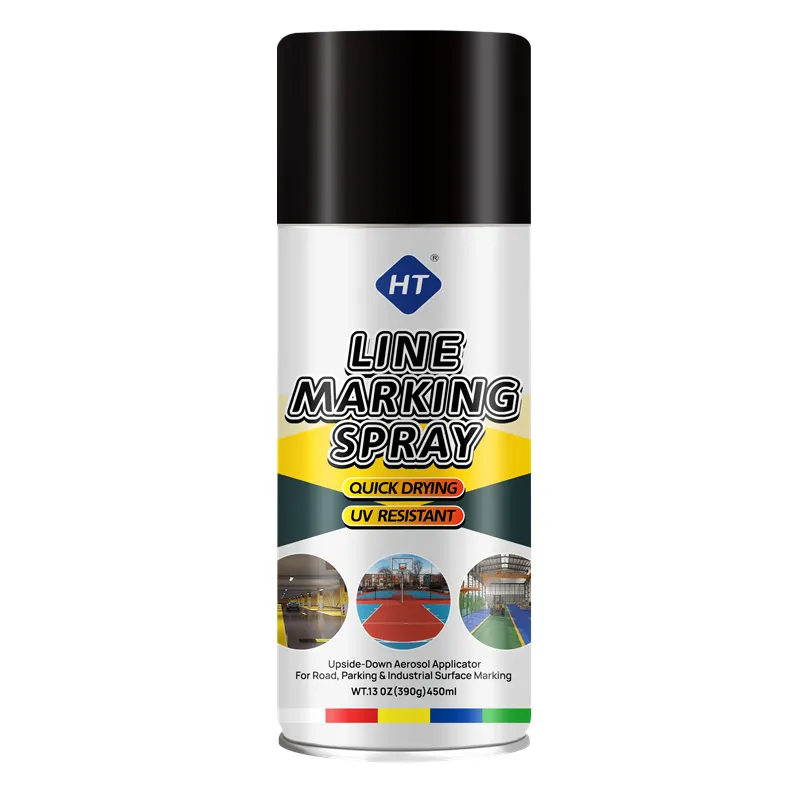
For colour work our HT-012 line marking paint covers aisles, zones, and floor identification, with aerosol formats suited to valves, fittings, and short runs. The commercial point for a facility or distributor is simple: one documented scheme, one supplier, consistent colour - that is what keeps an audit clean and prevents the full repaint five years later.