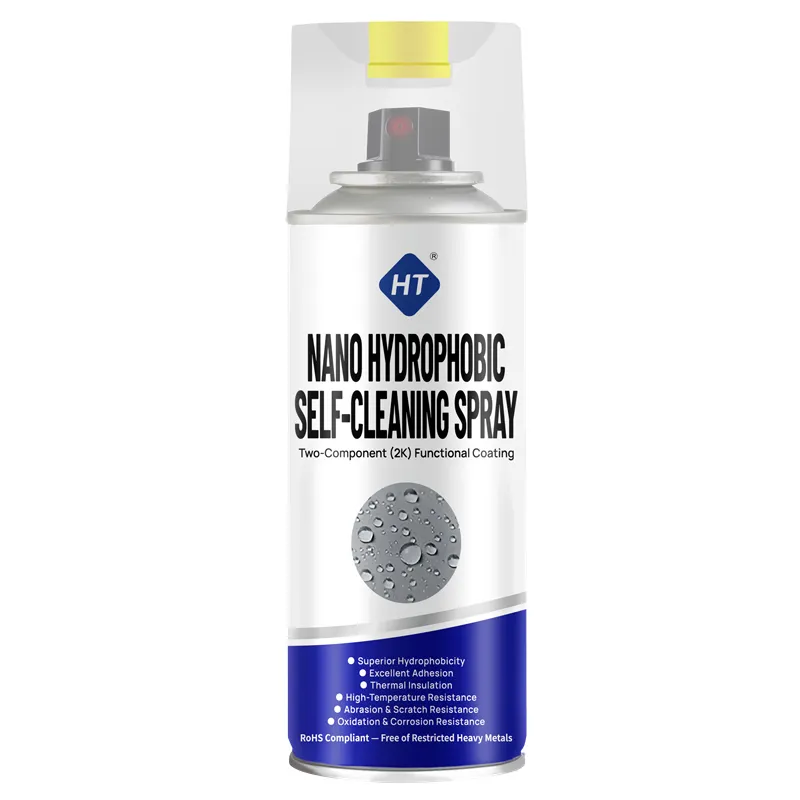
How do nano hydrophobic coatings actually work?
Hydrophobicity is quantified by the water contact angle — the angle formed between a water droplet and the coated surface. Surfaces with a contact angle greater than 90 degrees are hydrophobic (water beads up); greater than 150 degrees is superhydrophobic (the lotus effect).
Nano coatings work by creating a microscopically textured, low-surface-energy film. The coating formula contains fluoropolymer or silane/siloxane compounds that bond chemically to the substrate and orient their non-polar molecular groups outward. These groups repel water molecules, causing droplets to bead and roll off.
The self-cleaning mechanism: when water beads into near-spherical droplets, they roll off the surface at the slightest angle, picking up dirt, dust, and grime as they go. This is why coated glass, car paint, and ceramic surfaces stay cleaner longer and require less active cleaning.
Key distinction for buyers: true nano coatings form chemical bonds with the substrate (durable, 6-24 months on outdoor surfaces), while silicone-based water repellents simply deposit a film (short-lived, 1-3 months). The can label may say nano but the actual durability depends on the chemistry. Check whether the product claims chemical bonding and cite a contact angle spec.
What contact angle and durability should a quality product deliver?
Performance specifications to look for:
Water contact angle: Quality hydrophobic coatings should deliver 100-120 degrees on glass and painted surfaces shortly after application. Superhydrophobic products claim 150+ degrees but are typically less durable because the microscopic texture that creates extreme water beading is fragile. For most applications, 105-115 degrees is the practical sweet spot.
Durability: Measured by how long the coating maintains its contact angle under real-world conditions. Good automotive-grade coatings: 6-12 months. Industrial-grade coatings on glass: 12-24 months. Budget silicone-based products: 1-3 months. Request the manufacturer's weathering test data (QUV or outdoor exposure) with contact angle measurements at intervals.
Water beading / runoff test: The practical test — apply the coating, let it cure, then pour water over a tilted surface. Coated surfaces should shed water completely with no wetting film. Water should run off in distinct droplets, leaving the surface dry within seconds.
Additional properties to verify: UV resistance (does the coating yellow or degrade in sunlight?), chemical resistance (does it survive car wash chemicals or industrial cleaners?), and compatibility with the substrate (some coatings etch or stain certain plastics and anodized aluminum).
Huotian's HT-024 Nano Hydrophobic Self-Cleaning Spray delivers 105-115 degrees contact angle on glass and painted metal, with outdoor durability of 6-12 months and a low surface energy film that rejects dirt and water.
How is nano coating applied for maximum performance?
Application quality determines 50% of the result. Here is the correct process:
1. Clean the surface: The substrate must be absolutely clean — free of wax, oil, silicone residue, and dust. Use a dedicated degreaser or isopropyl alcohol wipe. For automotive use, a clay bar treatment before coating removes embedded contaminants.
2. Dry completely: Coating on a damp surface will not bond. Wipe dry with a microfiber towel and allow 5-10 minutes for full evaporation.
3. Apply thin, even coats: Spray from 15-20cm distance in light, sweeping passes. One thin coat is usually sufficient — multiple heavy coats create a hazy film that reduces clarity. Over-application is the most common DIY mistake.
4. Allow flash time: Wait 1-3 minutes for the coating to begin curing (the surface will look like it is disappearing / becoming invisible as the solvent evaporates).
5. Buff to a shine: Use a clean microfiber towel to buff the surface. This removes excess coating and activates the hydrophobic layer. The surface should feel slick to the touch after buffing.
6. Cure before use: Full cure takes 24-72 hours depending on temperature and humidity. Avoid water contact and washing during this period. The coating reaches maximum hardness after 7 days.
B2B note: if you sell nano coating for automotive detailers, provide the full 6-step process on the label or a QR code to a video. Proper application is the difference between a product that generates rave reviews and one that generates returns.
What should B2B buyers look for in a nano coating supplier?
Five evaluation criteria for sourcing nano hydrophobic coatings:
1. Chemistry documentation: Request the formulation type (fluoroalkylsilane, perfluoropolyether, or silicone-based). Fluoropolymer-based coatings provide the best durability and water repellency. Silicone-based products are cheaper but far less durable. Know which you are buying.
2. Test data: Request contact angle measurements, water runoff test results, and QUV weathering data. A serious supplier has this documentation ready. A supplier who cannot provide contact angle data is selling commodity water repellent, not nano coating.
3. Substrate compatibility: Verify the coating works on your target substrates (glass, metal, ceramic, specific plastics). Some hydrophobic coatings fail on polycarbonate or acrylic — they etch or cause crazing. Test on your actual product materials.
4. Packaging and dosage: Aerosol cans must deliver the right dosage. A 400ml can should coat approximately 20-40 square meters when applied correctly (thin single coat). Request the coverage spec and test it — under-dosing leads to incomplete coverage and customer complaints.
5. Shelf life and stability: Hydrophobic coating formulas can separate or degrade over time, especially fluoro-silane solutions that react with moisture. Verify shelf life (minimum 18-24 months) and that the formula remains stable after freeze-thaw cycles. Request stability test data.
6. VOC compliance: Some hydrophobic coatings use high-VOC solvents. If you target CARB or EU markets, verify the product meets the destination market's VOC limits. Low-VOC versions are available but verify performance is not compromised.