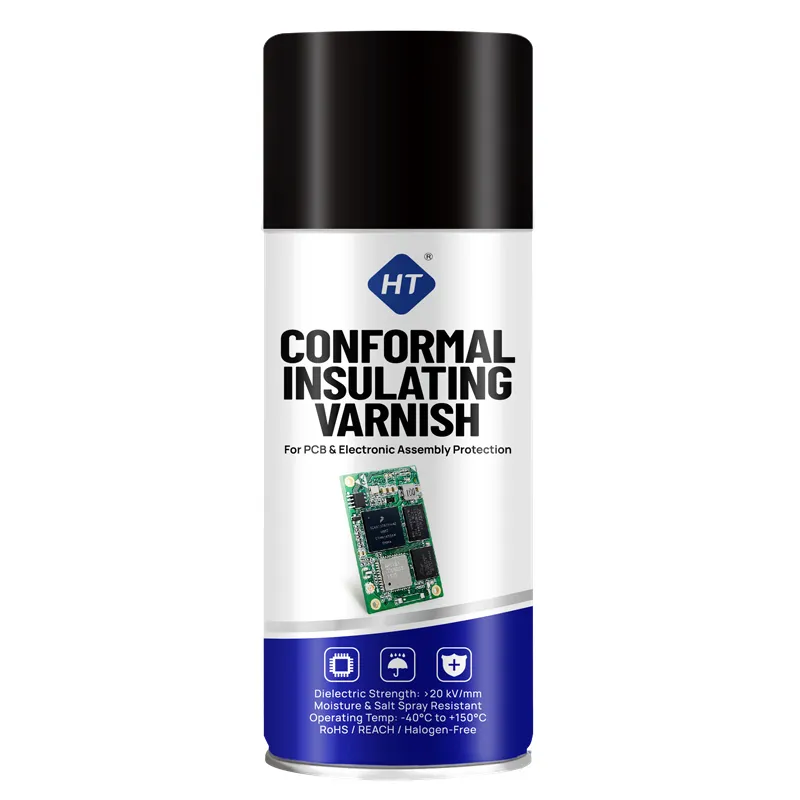
What is conformal coating and why do PCBs need it?
Conformal coating is a thin (25-75 micron) polymer film applied to a printed circuit board that conforms to the board's contours, components, and solder joints. It protects the board from environmental threats that cause corrosion, short circuits, and premature failure:
Moisture: The leading cause of PCB failure. Moisture creates conductive paths between traces and causes electrochemical migration, corrosion of copper traces, and dendritic growth (tin whiskers) that short circuits.
Dust and contamination: Conductive dust (carbon, metallic particles) can bridge traces. Salt spray in coastal and marine environments accelerates corrosion dramatically.
Chemicals: Flux residue, solvents, cleaning agents, and atmospheric pollutants attack solder joints and copper.
Mechanical stress: Coating adds a protective layer that absorbs vibration and reduces wire fatigue at solder joints.
Temperature cycling: Coating reduces stress on components during thermal expansion and contraction.
Where conformal coating is essential: outdoor LED lighting, automotive electronics (ECUs, sensors), EV charging stations, marine electronics, industrial control panels, HVAC controllers, and any electronics exposed to humidity, temperature swings, or contamination.
What are the main conformal coating chemistries and how do they compare?
Five coating chemistries dominate the market, each with different strengths:
1. Acrylic (Type AR): The most common and easiest to apply. Excellent moisture resistance, good dielectric properties, easy repair (soluble in common solvents), and reasonable cost. Limited solvent and abrasion resistance. Best for general-purpose protection. This is the chemistry used in aerosol conformal coatings like Huotian's HT-006.
2. Silicone (Type SR): Excellent high-temperature performance (up to 200 deg C) and flexibility. Superior moisture protection in high-humidity environments. Expensive and difficult to repair. Best for automotive and high-temperature applications.
3. Polyurethane (Type UR): Excellent solvent and chemical resistance, good abrasion resistance. Higher cost, requires moisture-free application. Best for fuel-exposed and chemically aggressive environments.
4. Parylene: Applied by vacuum deposition, not spray. Extremely thin (1-25 microns), complete coverage, excellent protection. Very expensive and requires specialized equipment. Best for medical implants and MEMS devices.
5. UV-curable: Fast curing with UV light, good adhesion, single-component. Requires UV exposure capability. Best for high-volume production lines.
For B2B buyers: acrylic conformal coating in aerosol form is the most practical entry product — easy application, good protection, repairable, and cost-effective. Silicone is specified when high temperature is the dominant risk. Polyurethane when chemical exposure is the dominant risk.
How do you apply conformal coating from an aerosol can?
Aerosol conformal coating application is a balance of coverage and control:
1. Clean the board: Flux residues and contamination reduce adhesion and cause coating defects. Clean with an appropriate flux remover (Huotian HT-026 Electrical Contact Cleaner or isopropyl alcohol). Allow to dry completely — moisture trapped under the coating causes blistering and corrosion.
2. Mask sensitive areas: Connectors, edge connectors, test points, and components that must not be coated (potentiometers, switches, relays) need masking. Use masking tape or a peelable mask. Some applications use a temporary peelable coating (HT-028) for this purpose.
3. Apply in thin passes: Hold the can 15-25cm from the board. Apply 2-3 thin passes rather than one heavy coat. Total film thickness of 25-75 microns is typical. Heavy coats trap solvent and cause bubbles, which reduce protection.
4. Follow circuit board orientation: Spray along the board surface, not directly down, to achieve even coverage. Tilt the board for better access to component underside areas.
5. Cure: Acrylic conformal coatings cure by solvent evaporation. Touch dry in 30-60 minutes, full cure in 24 hours. Do not power the board until fully cured — solvent trapped under components can cause corrosion when energized.
Critical rule: conformal coating protects what it covers. A single uncoated area, a bubble, or a missed component is a failure point. Coverage inspection with UV light (many acrylic coatings contain a UV tracer dye) is standard practice in professional applications.
What should B2B buyers specify when sourcing conformal coating?
Five specifications matter for conformal coating procurement:
1. Coating chemistry and type: Specify the IPC-CC-830 type (AR acrylic, SR silicone, UR polyurethane, XY parylene, ER epoxy). Acrylic Type AR is the standard for aerosol application.
2. Dielectric strength: The coating must insulate against electrical breakdown. Standard acrylic conformal coatings provide 50-100 kV/mm dielectric strength. Specify minimum dielectric strength for your application voltage.
3. Insulation resistance: The coated board must maintain high insulation resistance (typically greater than 10^12 ohms) under humid conditions. Request test data per IPC-CC-830 or IEC 61086.
4. Temperature range: Specify the operating temperature range. Standard acrylic: -40 to +125 deg C. Silicone: -60 to +200 deg C. Match the chemistry to your temperature environment.
5. Coverage and yield: A 400ml aerosol can should cover approximately 3-5 square meters of board surface at 50 microns dry film thickness (dependent on application technique). Request the coverage spec and verify with a test application.
Also verify: shelf life (minimum 12-18 months), VOC compliance for your target market, and repairability (acrylic coatings are soldered through and re-coated easily; silicone requires full removal before repair).