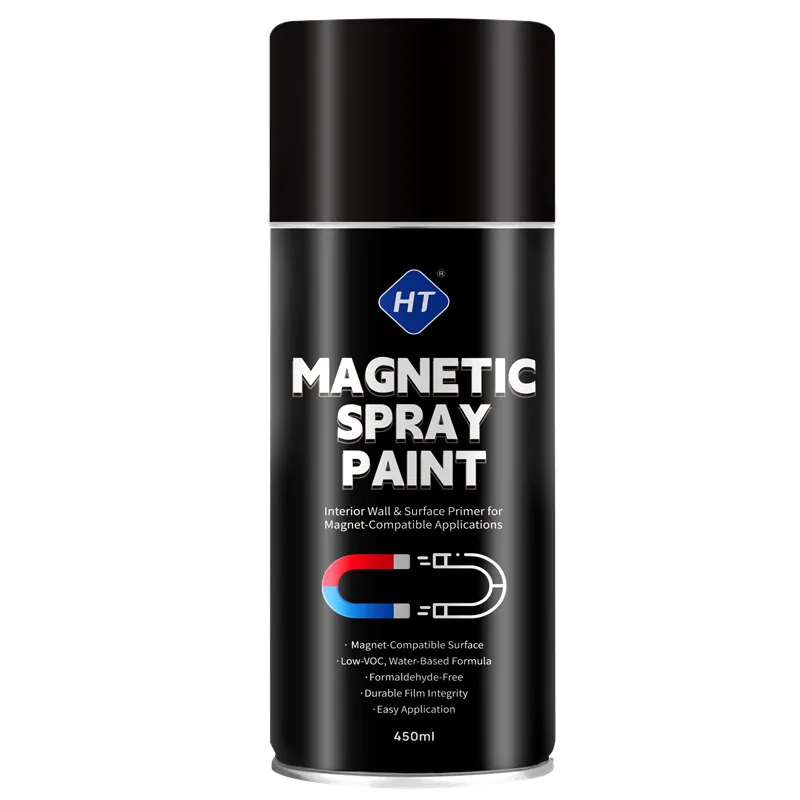
How does magnetic spray paint work?
Magnetic spray paint contains finely ground iron or ferromagnetic particles suspended in a paint binder. When applied to a surface, these particles create a layer that magnetic objects can adhere to.
Key points about the technology: - Iron particle content: Higher iron content = stronger magnetic hold. Premium formulations contain 40-60% iron particles by weight. - Coat layers: Typically 3-4 coats are required for useful magnetic hold. Each coat adds more iron particles to the surface. - Topcoat compatibility: Can be topcoated with standard wall paint (latex, acrylic) without losing magnetic properties. The magnetic particles remain accessible through the paint film. - Not all magnets work: Only strong rare-earth magnets (neodymium) or ferrite magnets provide reliable hold. Lightweight paper magnets or business card magnets may not stick.
The finished surface looks like regular painted wall. The iron particles are microscopic and do not affect appearance, but they do create a slightly textured surface that may be noticeable if a high-gloss finish is applied.
Where is magnetic spray paint used in residential and commercial settings?
Common applications span both consumer and commercial markets:
Residential: - Home offices: Create a magnetic wall behind a desk for notes, reminders, and small items. - Kitchens: Magnetic spice rack mounting, recipe card holders, and utensil organization. - Childrens rooms: Art display walls, homework organization, and interactive learning surfaces. - Craft rooms: Pattern storage, tool organization, and inspiration boards.
Commercial and industrial: - Retail: Point-of-sale displays, product information boards, and seasonal promotion walls. - Education: Classroom display walls, interactive learning surfaces, and science lab organization. - Workshops and garages: Tool organization, wrench and socket holders, and parts bin mounting. - Restaurants: Menu board mounting and kitchen organization.
The industrial market for magnetic coatings also includes MRI room shielding, sensor housing, and electronic component organization.
What are the limitations of magnetic spray paint?
Buyers should understand these realistic limitations:
- Weight capacity: A single coat holds approximately 5-10 grams. Four coats can hold 50-100 grams. This is enough for photos, notes, and small tools, but not heavy items. - Surface requirements: Must be applied to smooth, clean, dry surfaces. Textured walls (orange peel, knockdown) reduce magnetic contact area and weaken hold. - Not a replacement for magnetic sheet: For heavy-duty applications (holding power tools, large signs), magnetic paint is not sufficient. Use magnetic sheet or direct-mount magnets instead. - Environmental factors: Magnetic strength decreases slightly in extreme heat (above 120 deg F) as the binder softens. - Coverage is uneven without technique: Spraying technique affects iron particle distribution. Consistent, even passes produce better results than spot application.
For B2B buyers developing magnetic paint product lines, these limitations should be clearly communicated on product labels and technical data sheets.
How do you apply magnetic spray paint for best results?
Application technique directly affects magnetic hold strength:
- Surface preparation: Clean and degrease the wall. Apply a primer coat for better adhesion on drywall, plaster, or previously painted surfaces. - Coating sequence: Apply 3-4 thin coats, allowing 2-4 hours between coats. Thinner coats provide better iron particle distribution than one thick coat. - Drying orientation: Apply while the wall is vertical (its installed position). The iron particles settle slightly during drying, concentrating on the outer surface where magnetic objects attach. - Topcoat: After the final magnetic coat cures (24 hours), apply a standard latex or acrylic topcoat. Use light, even strokes to avoid disturbing the iron particles. - Magnetic test: Test with your intended magnets after 48 hours of full cure. If hold is weak, add another coat of magnetic paint.
For aerosol application: Hold 8-12 inches from the surface. Use overlapping horizontal passes. Avoid heavy buildup in any single area.