What's the Fundamental Difference Between 1K and 2K Spray Paint?
The difference is curing chemistry. 1K (one-component) paints like standard enamel or lacquer dry by solvent evaporation — the liquid solvent leaves, and the remaining resin forms a film. This is a physical drying process, meaning the coating can be re-dissolved by solvents later. 2K (two-component) paints like polyurethane or epoxy contain a resin and a separate hardener (catalyst) that must be mixed before application. Once mixed, a chemical cross-linking reaction begins — the molecules bond together into a three-dimensional network. This is thermoset chemistry: once cured, 2K coatings cannot be re-dissolved and form a much harder, more chemical-resistant, and more durable film. For comparison: a good 1K enamel might resist solvents for 30-60 seconds; a 2K polyurethane withstands continuous fuel, oil, and chemical exposure. The trade-off is working time — 2K paint has a pot life (typically 4-8 hours after activation) after which it hardens in the can.
When Should I Choose 2K Polyurethane Over 1K Enamel?
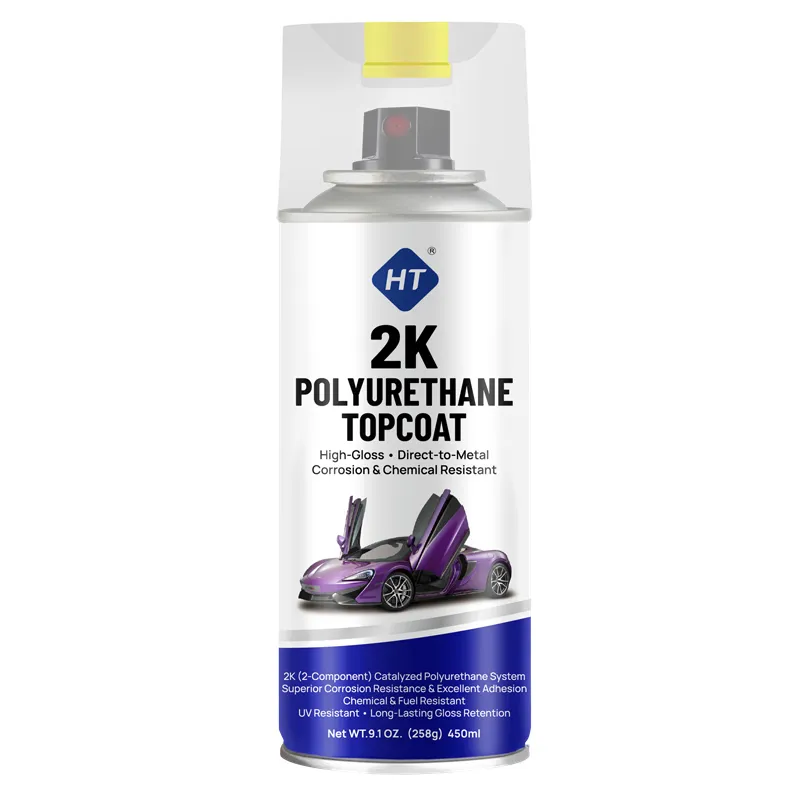
Choose 2K polyurethane when the coated surface will face demanding conditions: (1) Automotive refinishing — wheels, trim, engine bays, and exterior panels that need fuel resistance and UV stability. (2) Industrial equipment — machinery, tools, and components exposed to oils, coolants, and cleaning solvents. (3) Marine applications — hulls, decks, and fixtures exposed to saltwater, sunlight, and abrasion. (4) Chemical environments — laboratory equipment, chemical storage areas, and processing plant surfaces. Choose 1K enamel for less demanding applications: indoor decorative painting, non-contact surfaces, temporary coatings, or where budget is the primary concern. Our HT-009 2K Polyurethane Topcoat, for example, provides chemical resistance comparable to automotive OEM finishes — it's the right choice when coating failure would mean costly downtime or safety risks.
How Does the Application Process Differ for 2K Aerosol vs 1K Aerosol?
The application technique is similar, but 2K requires more attention to setup and curing. For our HT-009 2K Polyurethane Topcoat (aerosol format): activation requires pressing a built-in activator button to release the hardener into the can — shake vigorously for 2 minutes after activation, then you have approximately 8 hours of useable pot life. Surface preparation is more critical for 2K — the chemical bond is stronger, but poor adhesion means catastrophic failure (large-scale peeling) rather than gradual wear. Apply 2-3 thin coats with 10-15 minute flash-off between coats. Cure time: tack-free in 30 minutes, handle-dry in 2-4 hours, full chemical resistance at 7 days. 1K enamel dries faster (tack-free in 10-20 minutes, handle-dry in 1-2 hours) but reaches only about 60-70% of the hardness and chemical resistance of 2K. Important: 2K paints generate isocyanate vapors during curing — proper respiratory protection (supplied air or NIOSH-approved organic vapor respirator) and ventilation are mandatory.
Is 2K Spray Paint Worth the Extra Cost for B2B Buyers?
For B2B buyers purchasing in volume, the value equation depends on the application. A 2K aerosol like HT-009 costs 40-60% more per can than a premium 1K enamel. However, consider total lifecycle cost: a high-quality 2K finish on a piece of industrial equipment can last 5-10 years without refinishing, versus 1-3 years for 1K enamel in demanding environments. When you factor in labor cost for reapplication, downtime for equipment removal, and customer satisfaction from longer-lasting finishes, 2K is often the more economical choice. For automotive body shops, 2K polyurethane is the industry standard — customers expect OEM-level durability and gloss retention. For industrial MRO, 2K is ideal for high-value assets. For budget-sensitive decorative applications, 1K enamel remains a practical choice. We recommend stocking both: HT-009 for critical applications and our standard 1K enamels (HT-002, HT-008, HT-022) for general use.
How Does Huotian's HT-009 2K Compare to Traditional Spray Gun Systems?
Our HT-009 2K Polyurethane Topcoat bridges the gap between professional spray-gun systems and standard aerosol convenience. Traditional 2K spray gun systems require mixing measured ratios of paint and hardener, thinning with reducer, adjusting gun pressure, and cleaning equipment with solvent after each use — significant setup and cleanup overhead. HT-009 delivers the same 2K polyurethane chemistry in a self-contained aerosol can with a built-in activator. This means no mixing errors (the hardener is pre-measured), no spray gun to clean (dispose of the can when done), and no compressor or air line required. The finish quality approaches spray-gun levels (DOI — Distinctness of Image — comparable to mid-range spray guns) in a fraction of the setup time. For repair shops, field service teams, and small-batch production runs, HT-009 offers professional 2K performance without the equipment investment.