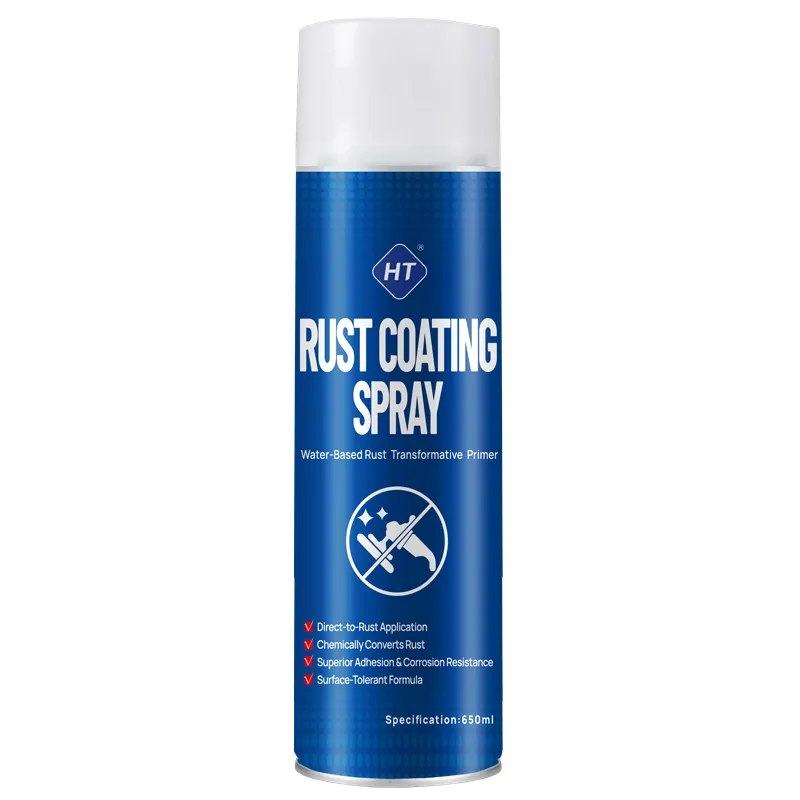
Rust prevention sprays fall into three main categories. Rust converters chemically transform existing rust into a stable black layer (HT-019 Rust Converter). Cold galvanizing sprays deposit a zinc-rich coating that provides sacrificial protection (HT-017 Cold Galvanizing Spray). Anti-rust coating sprays form a durable barrier that seals out moisture and oxygen (HT-020 Rust Coating Spray). Each addresses a different stage of metal protection.
Rust converters are ideal when you have existing rust on a surface that cannot be fully removed by sanding. HT-019 Rust Converter penetrates rust layers and chemically stabilizes them, creating a primed surface ready for topcoating. This saves labor time compared to grinding rust down to bare metal. Rust converters are commonly used on automotive underbodies, industrial structural steel, farm equipment, and marine applications where complete rust removal is impractical.
Cold galvanizing spray like HT-017 delivers 95%+ zinc content in the dry film, providing cathodic protection similar to hot-dip galvanizing. It's ideal for touch-up after welding, for hard-to-dip structures, and for on-site repairs. While hot-dip galvanizing offers thicker, longer-lasting protection, cold galvanizing is far more practical for field application, maintenance, and OEM production where dip tanks aren't feasible.
Any industry with metal assets benefits. Construction uses cold galvanizing on steel structures. Automotive uses rust converters on chassis and underbodies. Marine applications need anti-corrosion coatings on deck hardware. MRO facilities stock rust coating sprays for equipment maintenance. Agricultural buyers protect tractors, irrigation systems, and storage silos. Huotian's rust prevention products serve all these sectors with ISO 9001 quality.
Surface preparation directly determines coating lifespan. For rust converters, remove loose rust and dirt, then apply to firm rust. For cold galvanizing, blast or grind to near-white metal (SSPC-SP10) for best adhesion. For rust coating sprays, clean the surface of oil, grease, and loose particles. In all cases, the surface must be dry. Proper preparation extends coating life by 3-5x compared to poorly prepared surfaces.