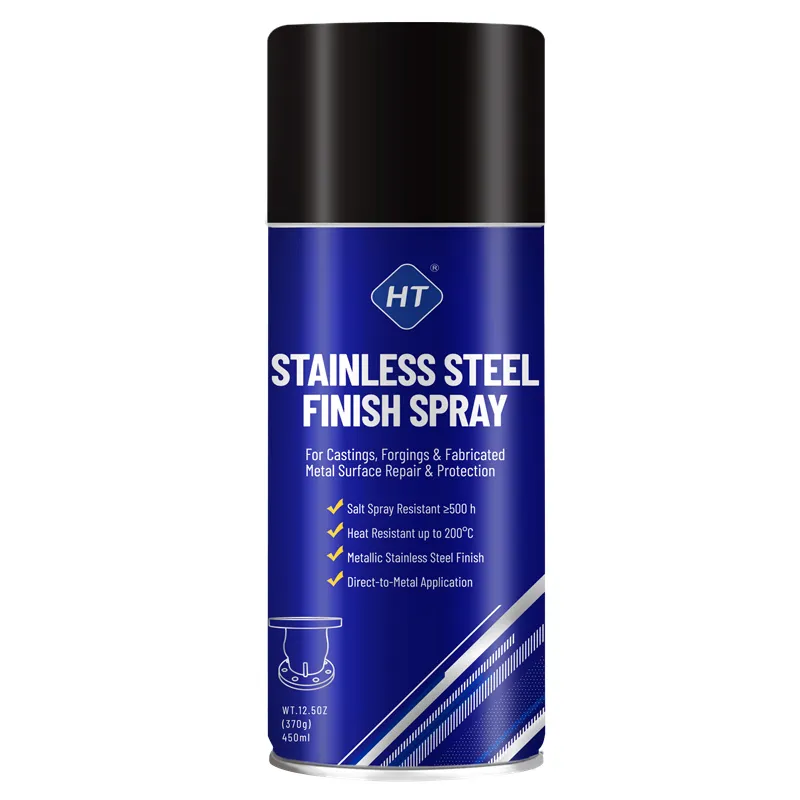
When Should You Use Stainless Steel Spray Paint Instead of Replacing the Metal?
Replacing stainless steel components is expensive and often unnecessary. Stainless steel spray paint is the right solution in these scenarios: Cosmetic restoration — scratched or scuffed stainless steel appliances, range hoods, refrigerator panels, and commercial kitchen equipment can be refinished at 10-20% of replacement cost. Heat-damaged surfaces — stainless steel develops a rainbow-like heat tint when exposed to high temperatures (welding, cooking equipment, exhausts). A quality stainless steel paint like HT-008 restores uniform appearance. Matching new additions — when adding a new stainless piece to an existing installation, slight color differences are common. A topcoat of stainless paint eliminates mismatches. Industrial equipment — stainless steel control panels, machine guards, and architectural trim that have faded or oxidized over time. Fabrication shortcuts — for manufacturers, painting carbon steel with a stainless steel finish is often more cost-effective than fabricating from actual stainless, while achieving the same visual result for non-corrosive environments.
What Makes Huotian HT-008 Stainless Steel Finish Different from Regular Silver Paint?
This is the most common misconception. Regular silver or aluminum paint uses standard metallic pigments that give a flat, gray-silver finish. HT-008 Stainless Steel Finish is formulated differently in three ways: (1) Proprietary stainless steel pigment blend — the pigments are engineered to mimic the warm, slightly blue-gray undertone of real brushed stainless steel, rather than the cold, bright appearance of aluminum paint. (2) Two-tone effect — HT-008 creates a subtle directional sheen that shifts with light, similar to how real brushed stainless steel reflects differently depending on the viewing angle. (3) Durability — the acrylic-urethane binder system provides better scratch resistance and UV stability than general-purpose silver paints, maintaining the stainless look for 3-5 years in indoor environments. For B2B buyers, specifying a dedicated stainless steel finish rather than generic silver paint ensures your products or repairs deliver the premium appearance that end customers expect from stainless steel. This matters in kitchen equipment, retail fixtures, and architectural applications where appearance directly affects perceived value.
How to Prepare Stainless Steel for Painting — Step by Step
Stainless steel's corrosion resistance comes from a passive chromium oxide layer — and that same layer makes paint adhesion difficult. Professional preparation: Step 1 — Degrease with acetone or isopropyl alcohol. Stainless steel often has manufacturing oils, fingerprints, and silicone residues. A clean surface is non-negotiable. Step 2 — Lightly abrade with 320-400 grit sandpaper or a scotch-brite pad. The goal is to create microscopic tooth for mechanical adhesion without scratching deep grooves. Use consistent circular or linear motion matching the desired grain direction. Step 3 — Wipe again with a tack cloth to remove all sanding dust. Step 4 — Apply a thin mist coat of HT-008 as a tack coat, wait 5-10 minutes. Step 5 — Apply 2-3 even wet coats, allowing 15-20 minutes between coats. Step 6 — For maximum durability, apply a clear urethane topcoat (compatible with HT-008) for high-wear applications like commercial kitchen handles. For industrial OEM applications, we recommend testing adhesion with a cross-hatch tape test (ASTM D3359) on a sample panel before full production.
Can Stainless Steel Spray Paint Be Used Outdoors?
Yes, but with caveats. HT-008 is designed primarily for interior applications where it delivers 3-5 year durability. For outdoor use: UV exposure — stainless steel paint will eventually fade or yellow under direct sunlight. A UV-resistant clear coat extends outdoor life to 1-2 years. Temperature range — HT-008 handles continuous temperatures up to 200°F (93°C). This covers most outdoor architectural applications but not direct exhaust or cooking surfaces. Moisture — while the paint provides good moisture resistance, it is not a substitute for actual stainless steel in marine or chemical environments. For outdoor applications, we recommend: apply a corrosion-inhibiting primer (HT-031 Epoxy Primer) first, then HT-008, then a UV-stable clear topcoat. For permanent outdoor installations where appearance matters long-term, actual stainless steel remains the better choice. HT-008 is best suited for interior restoration, retail fixtures, and decorative applications.