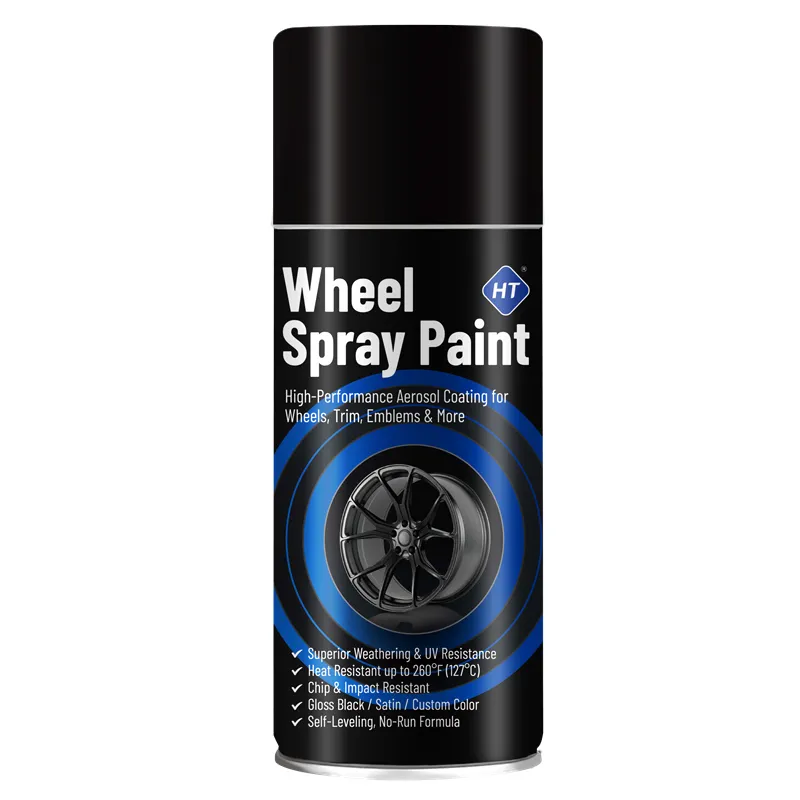
Wheel Spray Paint (HT-004): When Do Customers Need Dedicated Wheel Paint?
Standard spray paint fails on wheels for three reasons: heat, impact, and UV exposure. Regular enamel softens and peels when brake heat radiates through the wheel surface during driving. Our HT-004 Wheel Spray Paint is formulated with a heat-resistant resin system rated to 260°F (127°C) — enough for alloy and steel wheels under normal driving conditions. The chip-resistant film withstands stone impacts, and UV stabilizers prevent fading after months of direct sunlight. Distributors should recommend HT-004 to customers who: (1) want to refinish worn, scuffed, or corroded wheels instead of replacing them ($200-$600 savings per wheel), (2) are changing wheel color for a custom look, or (3) need to touch up curb rash on leased vehicles before return. Available in gloss black, silver, and custom-matched colors. For brake calipers specifically, recommend customers apply our HT-001 High Temperature Spray Paint (2000°F rated) instead — brake calipers generate higher surface temperatures than wheels.
Leather Spray Paint (HT-015): Is It Viable for Professional Interior Restoration?
Yes — and professional detailers and interior shops are the primary buyers. HT-015 Leather Spray Paint is a flexible, crack-resistant coating that matches original leather texture. The key technical advantage is its elastomeric film: when the leather stretches during seating or flexing, the paint film stretches with it without cracking. Typical flex test results show >200% elongation before failure, compared to <50% for standard spray paint. UV stabilizers prevent the fading and stiffening that cheaper leather dyes suffer after 6-12 months of sun exposure. Common applications for distributors' customers: automotive leather seat restoration (worn side bolsters, faded seat cushions), vinyl dashboard color changes (black to tan or gray), boat upholstery repair (marine-grade UV package), and furniture leather touch-up. Important purchasing note: recommend customers buy 3-4 cans per full car interior — a single front seat typically requires 1.5-2 cans for proper coverage. Pre-cleaning with a mild degreaser and light scuffing with a gray scuff pad improves adhesion significantly.
Vinyl & Hard Plastic Refinish Spray (HT-016): How Does It Differ from Leather Paint?
HT-016 is specifically formulated for hard interior plastic surfaces — door panels, dashboards, armrests, center consoles, and instrument panel trim. The critical difference from HT-015 Leather Spray is the adhesion system: HT-016 contains a built-in adhesion promoter that chemically bonds to polypropylene (PP), ABS, and PVC — three common automotive interior plastics that standard paint cannot adhere to long-term. Without this chemistry, paint on dashboards typically peels within 2-4 weeks due to thermal expansion (dashboards reach 160-180°F in summer sun). Our accelerated thermal cycling tests show HT-016 retains >95% adhesion after 500 cycles of -20°C to +85°C. For distributors, this means fewer customer complaints and returns. Common customer use cases: restoring faded gray/black door panels on 5-10 year old vehicles, changing interior color from beige to black for custom builds, and fleet vehicle interior refurbishment. One can typically covers both front door panels fully.
Epoxy Primer (HT-031): Why Should Body Shops Choose Aerosol Over Gun-Applied?
HT-031 Epoxy Primer serves a specific niche in the automotive repair market: spot repairs, small panels, and field repairs where setting up a spray gun system is impractical. The Direct-to-Metal (DTM) formula means customers can spray directly onto bare or sanded metal without a separate wash primer or etch primer step — saving 30-45 minutes per repair. Aerosol format eliminates cleanup (no gun washing), eliminates mixing errors (pre-mixed, just shake and spray), and is economical for bodyshops that do fewer than 5-10 primer jobs per week (the threshold where gun systems become more cost-effective). HT-031 provides the same corrosion resistance as professional 2K epoxy primers: 500+ hours salt spray resistance in ASTM B117 testing. For distributors serving independent body shops, collision centers, and mobile repair techs, stocking HT-031 alongside our HT-009 2K Polyurethane Topcoat creates a complete small-repair system that covers from bare metal to finished topcoat.